22 Cognitive Skills: What Your Cognitive Test Measures & Why It Matters
Ever wonder what's really happening in your brain when you take a cognitive test? Unlike simple quizzes or entertainment-focused "brain games," scientifically validated cognitive assessments actually measure distinct neurological capabilities that impact every aspect of your daily life. At CognitiveTest.me, our comprehensive evaluation analyzes 22 key cognitive skills—far more than standard memory quizzes—to give you unprecedented insight into your brain health. Discover how it works through our scientifically validated assessment.

Understanding the Foundation of Cognitive Assessment
The Science Behind 22-Skill Testing
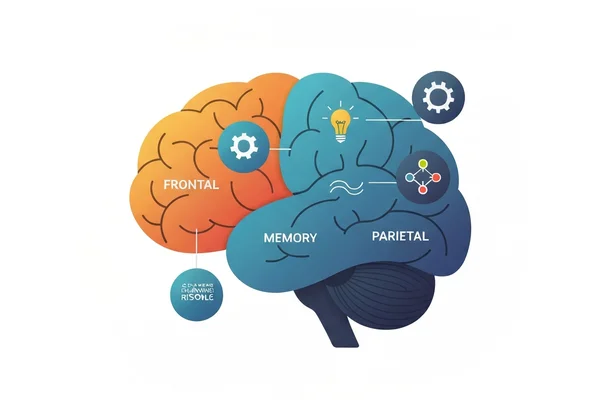
Cognitive assessments like ours aren't guessing games—they're grounded in decades of neuropsychological research. Where casual puzzles might measure reaction time alone, our cognitive function test evaluates specific skills mapped to brain regions:
- Frontal lobe functions (decision-making, planning)
- Temporal lobe processing (memory formation)
- Parietal lobe integration (spatial reasoning)
Developed with reference to gold-standard tools like CogniFit Cognitive Assessment (CAB)® and WoodcockJohnson Tests of Cognitive Abilities (WJIV COG), our assessment provides reliable data professionals trust. Take the assessment to receive your personalized brain health profile.
Why 22 Skills? The Comprehensive Approach
Most free online tests measure just 3-5 cognitive areas—often missing early signs of change. Our 22-skill cognitive assessment covers:
- Critical memory systems (working, short-term, long-term)
- Executive functions (problem-solving, cognitive flexibility)
- Information processing channels (attention, speed)
- Specialized abilities (language, visual-spatial skills)
This breadth matters because cognitive health isn't one-dimensional. Try our comprehensive test to identify subtle changes other screenings miss.
Memory Skills: Your Brain's Storage System
Working Memory & Short-Term Recall
Your working memory acts as a mental sticky note—holding phone numbers or directions briefly. Our tests measure:
- How many items you can retain (span test)
- How accurately you manipulate information (sequencing tasks)
- Resistance to distraction (interference tests)
Long-Term Memory Formation & Retrieval
Episodic memory (personal experiences) and semantic memory (facts/concepts) are assessed separately through:
- Story recall tasks measuring detail retention
- Word-pair association tests
- Delayed recall challenges
See how your memory stacks up with our detailed recall analysis.
Executive Functions: Your Brain's Management Team
Planning & Organization Skills
This domain evaluates strategic thinking through:
- Puzzle tasks requiring multi-step solutions
- Timed organizational challenges
- Resource allocation simulations
Declines often appear as difficulty managing finances or following recipes.
Cognitive Flexibility & Problem Solving
Our tests measure mental adaptability by:
- Switching rules mid-task (sorting exercises)
- Solving novel problems under time constraints
- Identifying patterns in changing scenarios
Get insights into your executive function with our adaptive assessment.
Attention & Processing: Your Brain's Information Highway
Sustained & Selective Attention
Focused attention is tested through:
- Vigilance tasks (detecting rare signals)
- Selective filtering (ignoring distractions)
- Divided attention challenges
Processing Speed & Information Integration
We measure milliseconds differences in:
- Symbol matching speed
- Visual scanning efficiency
- Decision reaction times
Assess your mental processing speed with our precision-timed tasks.
Language & Visual Skills: Your Brain's Communication Systems
Verbal Abilities & Language Processing
Tests include:
- Vocabulary recognition tasks
- Sentence construction accuracy
- Verbal fluency under pressure
Visual-Spatial Processing & Recognition
We evaluate:
- 3D object rotation accuracy
- Pattern completion skills
- Spatial navigation abilities
Test your full cognitive profile to uncover strengths like these.
Your Comprehensive Cognitive Profile Starts Here
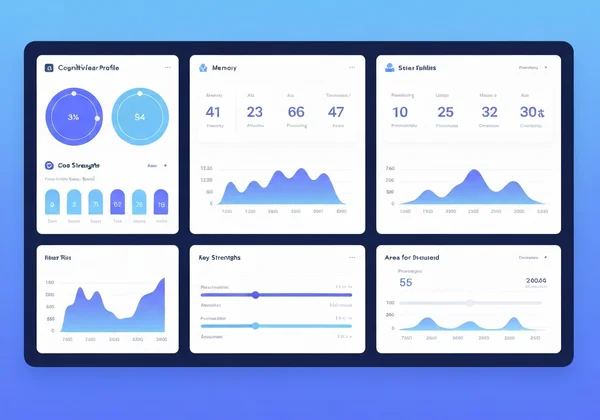
Understanding all 22 cognitive skills gives you something generic "brain games" can't: a scientifically validated map of your mental strengths and growth areas. Whether you're proactively monitoring your brain health or seeking insights about a loved one's cognition, CognitiveTest.me's assessment provides:
- ✓ Personalized analysis across all cognitive domains
- ✓ Age-normed comparisons (7+ years old)
- ✓ Actionable strategies tailored to your results
Don't settle for partial insights. Start your free cognitive assessment now to access your complete neurological profile.
Cognitive Skills Testing Explained
It's worrying to get a low score. What does it actually mean?
First, don't panic! It's completely normal for our cognitive skills to fluctuate day-to-day. A single lower score is a data point, not a diagnosis. Our report is designed to be a starting point, offering personalized strategies to help you strengthen those specific areas. If you have serious concerns about your results, it's always a great idea to share them with a healthcare professional.
Is my score permanent, or can I improve it?
Your score is absolutely not permanent! Think of it as a snapshot in time. The brain has an amazing ability to adapt and change, a concept known as neuroplasticity. With targeted brain training and healthy lifestyle choices, you can improve your cognitive abilities. That’s why many people re-take the assessment every 6-12 months to track their progress.
How often should I take a cognitive test?
For proactive health monitoring, we generally suggest an annual check-in if you're over 50, and every couple of years if you're younger. However, if you're actively working on cognitive improvement or have specific concerns, you might test more frequently. Our platform helps you track your cognitive profile over time so you can spot meaningful changes.
I already play brain games on my phone. How is this different?
While fun, most brain games are like doing just one type of workout, like only doing bicep curls. They’re great for that single skill but don't give a full picture of your overall fitness. Our scientifically validated test is like a comprehensive physical for your brain. It assesses 22 distinct, clinically relevant abilities, providing a holistic and reliable view of your cognitive health that entertainment apps simply can't match.