Cognitive Assessment for Adults: Tools, Questions, and What Results Mean
A cognitive assessment for adults can sound intimidating, especially if you are searching for a questionnaire PDF, a free cognitive test, or examples of the questions that may appear. In plain terms, it is a structured way to look at thinking skills such as attention, memory, language, reasoning, processing speed, and executive function. Some assessments are brief screens used in clinics. Others are longer evaluations completed with trained professionals. Online tools can also help adults reflect on patterns and prepare better questions for a clinician. If you want a calm first step, an educational cognitive assessment experience can help you explore your cognitive profile without treating one score as a medical diagnosis.

What an Adult Cognitive Assessment Is Actually Measuring
An adult cognitive assessment measures how a person handles different kinds of mental tasks. It is not the same as an IQ test, a school exam, or a single memory quiz. A useful assessment separates cognition into domains so the results can show a pattern rather than a vague label.
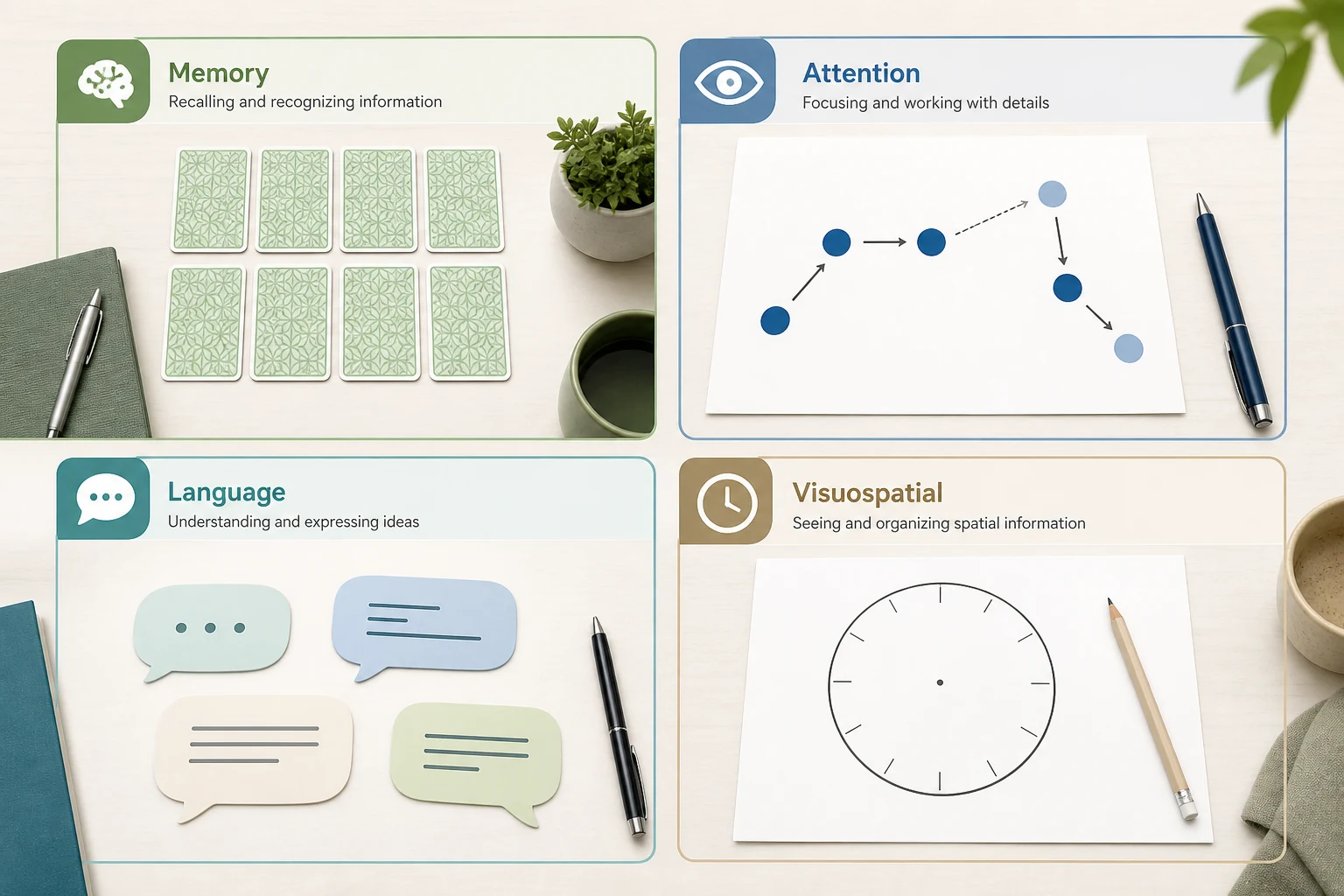
Common domains include attention, working memory, delayed recall, language, visual-spatial skills, mental flexibility, planning, processing speed, and judgment. A person may be strong in one area and less consistent in another. For example, someone may remember stories well but struggle when several tasks compete for attention. Another person may solve visual puzzles easily but need more time to process written instructions.
This domain-by-domain view is why adult assessment is more helpful than asking, "Is my memory good or bad?" It can show whether a concern is mostly about recall, focus, speed, organization, mood, sleep, stress, or another factor that deserves follow-up.
Screening Tools, Questionnaires, and Full Evaluations Are Not the Same
Search results often mix together cognitive assessment questionnaire PDF files, free cognitive tests for adults, and full neuropsychological assessment. They can all be useful, but they do different jobs.
A brief cognitive screen is usually short. It may ask a person to remember words, draw a clock, name objects, follow instructions, or complete a quick attention task. Screens are designed to flag whether more evaluation might be helpful. They are not meant to explain every cause of a concern.
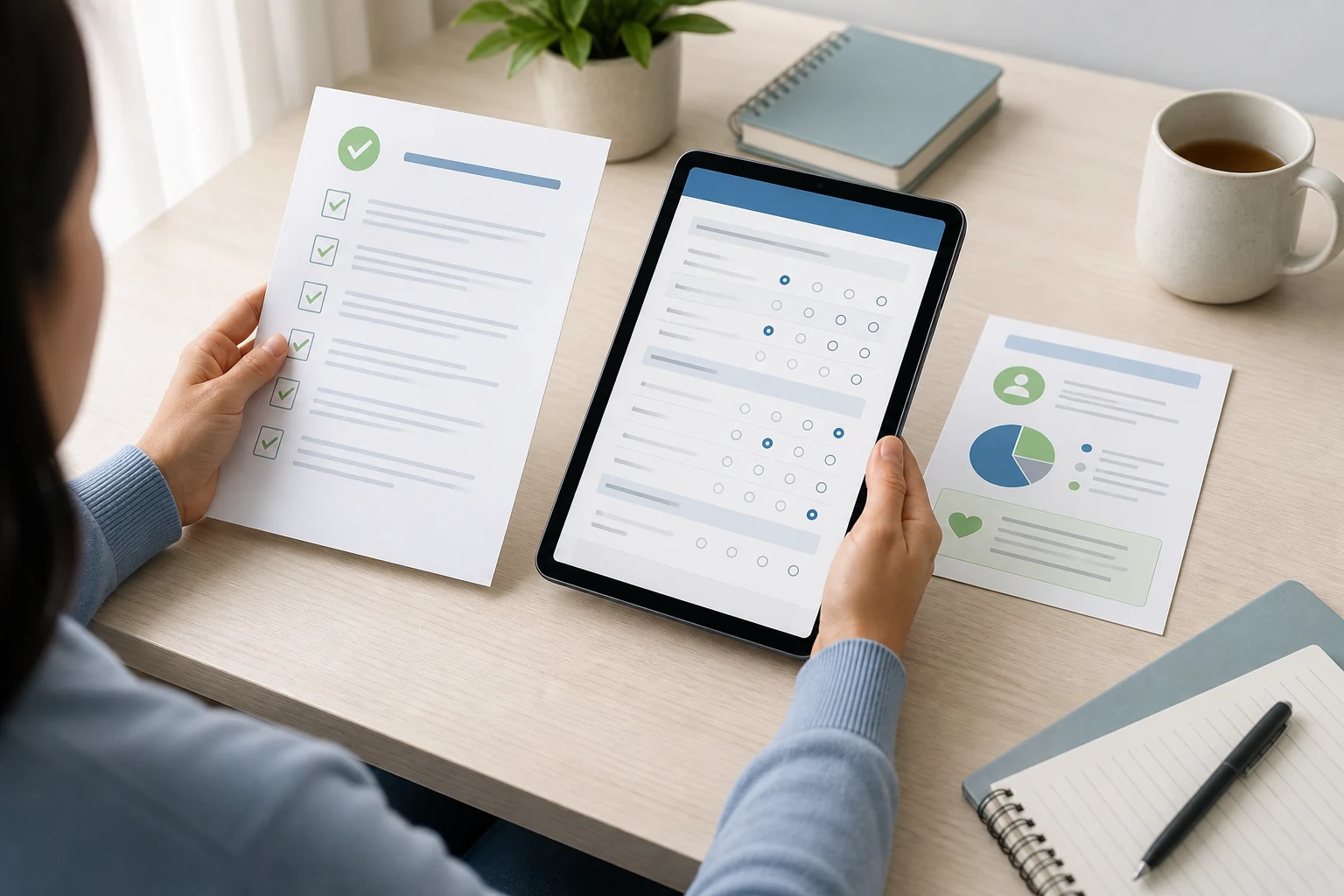
A questionnaire is usually based on self-report or caregiver observation. It may ask about recent changes in daily life, medication management, getting lost, word-finding, mood, or independence. A questionnaire can add important context, but it depends on accurate observation and honest answers.
A comprehensive evaluation is deeper. It may include several standardized tasks, background history, mood screening, education and work history, medical context, and interpretation by a trained clinician. This is the level that can support a more complete clinical picture.
Online assessments sit in a different category. A well-designed online tool can help adults reflect on cognitive strengths and challenges, especially when it covers multiple domains and explains limits clearly. It should not replace a professional evaluation when symptoms are new, worsening, or affecting safety. Used thoughtfully, it can give you a more organized adult cognitive profile to discuss with a healthcare professional.

What Are 4 Common Cognitive Assessment Tools for Adults?
Many tools are used in adult cognitive screening and assessment. Availability, licensing, scoring, and appropriate use vary by setting, so the best tool depends on the purpose and who is interpreting it. Four names appear often in adult cognitive assessment searches.
The Mini-Cog is a very brief screen. It commonly combines three-word recall with a clock-drawing task. Because it is short, it can be useful when time is limited, but a short screen gives limited detail.
The Montreal Cognitive Assessment, often called MoCA, is a broader brief screen. It samples areas such as attention, memory, naming, language, abstraction, orientation, and executive skills. It is often discussed in clinical contexts because it covers more domains than ultra-short screens.
The Mini-Mental State Examination, or MMSE, is one of the older and more widely recognized cognitive screens. It includes orientation, recall, attention, language, and simple commands. It is still discussed often, although modern practice may consider education, culture, licensing, and sensitivity limits.
The Self-Administered Gerocognitive Examination, known as SAGE, is a paper-based self-administered screen often searched as "sage test online" or "cognitive assessment pdf." It can be a useful conversation starter, especially for older adults, but results still need appropriate interpretation.
These tools are not interchangeable. A quick screen may answer, "Should we look more closely?" A fuller assessment asks, "What pattern of strengths and weaknesses appears, and what context might explain it?"
What Are the 30 Questions on a Cognitive Test?
People often search for the 30 questions on a cognitive test because some well-known screens use a 30-point scoring format. The exact items depend on the tool, version, language, and rules for administration, so it is better to understand the task types than to memorize a fixed answer sheet.
Adult cognitive tests may ask orientation questions, such as the date, location, or situation. They may include immediate recall, where you repeat a short list of words, and delayed recall, where you remember those words later. Attention tasks may involve repeating numbers, counting backward, spelling a word backward, or responding to a sequence. Language tasks may include naming objects, following a multi-step command, reading, writing, or repeating a phrase.
Visual-spatial and executive tasks may ask you to copy a shape, draw a clock, connect alternating numbers and letters, or explain how two ideas are alike. Judgment and reasoning tasks may ask how you would respond to a practical situation. None of these tasks is meant to make you feel clever or embarrassed. They are structured samples of everyday thinking skills.
That is also why looking for a "free cognitive test with answers" can be misleading. If you practice the exact answers, the score may no longer reflect your usual thinking. A better goal is to understand the format, sleep well, use needed glasses or hearing aids, and answer as naturally as possible.
How to Choose a Free Cognitive Test or PDF Resource
A free cognitive test or cognitive assessment PDF can be helpful if you choose it for the right reason. The safest approach is to judge the resource by transparency, scope, and next-step guidance.
Look for a clear purpose. Does the resource say whether it is a brief screen, a questionnaire, an educational self-check, or a professional assessment tool? If it claims to provide certainty from a few questions, be cautious.
Look for domain coverage. A strong adult cognitive assessment should explain which skills it samples: memory, attention, language, processing speed, visual reasoning, executive function, or daily functioning. A resource that only asks about memory may miss other important patterns.
Look for interpretation limits. A responsible tool explains that results can be affected by sleep, stress, pain, mood, medication, hearing, vision, language, education, and computer comfort. It should encourage professional help when changes are persistent, sudden, or affecting daily safety.
Look for privacy clarity. If the assessment is online, check what information is collected and how results are used. You should not need to share more personal information than the tool reasonably requires.
Finally, look for plain-language output. A score alone is rarely enough. Adults benefit more from a summary that separates strengths, challenges, and suggested next questions.
How to Interpret Results Without Overreacting
Cognitive assessment results are best understood as signals, not verdicts. A lower-than-expected score can happen for many reasons. Poor sleep, anxiety, depression, grief, pain, medication effects, illness, alcohol use, unfamiliar technology, language differences, or hearing and vision problems can all affect performance.
A normal score also does not always end the conversation. If you or someone close to you notices meaningful changes in work, finances, driving, medication routines, cooking, navigation, or conversation, it is reasonable to document examples and discuss them with a healthcare professional.
The most useful interpretation looks for patterns over time. One score is a snapshot. Repeated assessment, when done appropriately, can help show whether performance is stable, improving, or changing. That pattern can be more informative than a single result taken on a stressful day.
If the results are concerning, avoid making major assumptions from one tool. Bring the report, examples from daily life, medication lists, sleep notes, and relevant medical history to a professional appointment. The goal is not to panic. The goal is to ask clearer questions.

When Adults Should Seek Professional Guidance
An adult should consider professional guidance when cognitive changes are sudden, progressive, or disruptive. Examples include getting lost in familiar places, repeated missed bills, unsafe cooking mistakes, major word-finding problems, confusion about dates or appointments, personality changes, falls or balance changes, or family concerns that feel persistent.
Urgent medical care is especially important when thinking changes appear suddenly, after a head injury, with weakness, speech changes, severe headache, chest pain, fever, or other acute symptoms. Online tools and PDFs are not designed for urgent situations.
For slower changes, a primary care clinician can review medical history, medications, sleep, mood, labs, and daily functioning. They may use a brief cognitive screen and, if needed, refer for neurological or neuropsychological evaluation. Family members or care partners can help by bringing specific examples rather than only general statements like "memory is worse."
How to Use an Adult Cognitive Assessment Thoughtfully
A thoughtful adult cognitive assessment starts with the right mindset. You are not trying to pass, fail, or prove something about your worth. You are trying to understand how your thinking is working right now and whether the pattern deserves follow-up.
Before an assessment, choose a quiet time, use glasses or hearing aids if you normally need them, avoid multitasking, and note anything that might affect performance. Afterward, read the explanation before focusing on the score. Ask which domains were measured, what the result does and does not show, and what a sensible next step would be.
If you are using an online educational tool, treat the result as a starting point for reflection. CognitiveTest.me is built around a multi-domain assessment and an optional AI-supported report that explains strengths, challenges, and practical suggestions while staying within an informational role. You can review your cognitive strengths and challenges and decide whether the results are useful for a conversation with a qualified professional.
The best outcome is not a perfect score. It is a clearer picture: what seems steady, what feels harder than before, what context may matter, and what questions you want answered next.
FAQ
What are some common cognitive assessments for adults?
Common adult cognitive assessment tools include brief screens such as the Mini-Cog, MoCA, MMSE, and SAGE, along with longer neuropsychological evaluations. The right choice depends on the purpose, setting, and who will interpret the results.
What is the 10 question cognitive test?
Searchers may use "10 question cognitive test" to mean a very brief screen or questionnaire. These short tools can sample orientation, recall, attention, and daily functioning concerns, but they provide limited detail and should not be treated as a full evaluation.
Is a cognitive assessment questionnaire PDF enough?
A questionnaire PDF can organize observations about memory, attention, mood, and daily functioning. It is usually not enough by itself because self-report and caregiver observations need context from history, task performance, and professional judgment when concerns are significant.
Are free cognitive tests for adults useful?
They can be useful for education, self-reflection, and preparing better questions. Choose tools that explain their limits, cover multiple cognitive domains, and encourage professional support when changes are persistent or disruptive.
What should I do before a cognitive assessment?
Sleep as well as you can, use needed glasses or hearing aids, choose a quiet setting when possible, and avoid practicing exact answers. Bring medication information, examples of daily-life changes, and any prior results if you are seeing a professional.
How long from mild cognitive impairment to dementia?
There is no single timeline. Some people remain stable for years, some improve when contributing factors are addressed, and some progress over time. A qualified healthcare professional can help interpret risk based on symptoms, health history, testing, and follow-up changes.