Cognitive Assessment System Theory Uses and Evolution
Is it just stress? Maybe I’m just tired. Everyone walks into a room and forgets why they are there occasionally. But why does organizing a simple weekly schedule feel like climbing a mountain lately? It feels foggy, frustrating, and honestly, a little isolating.

When you feel confused or uncertain about how your brain is functioning, the search for answers can be overwhelming. You might look for ways to understand these patterns without immediately jumping to frightening medical labels. This is where understanding what is cognitive assessment system (CAS) frameworks becomes vital. Whether you are researching the specific Das-Naglieri clinical test for a child or looking for a modern digital tool to monitor your own brain health, the goal is the same: clarity.
Below, we explore the science behind these systems, how they differ from IQ tests, and how modern technology allows you to check your cognitive health baseline from the comfort of your home.
What Defines the Das-Naglieri Cognitive Assessment System?
The term "Cognitive Assessment System" often refers specifically to a standardized test developed by psychologists J.P. Das and Jack Naglieri. Now in its second edition (CAS2), educational and clinical settings widely use this system, particularly for children and adolescents aged 5 to 18.
Unlike older tests that measured how much knowledge a person had accumulated, the Das-Naglieri Cognitive Assessment System focuses on how a person thinks. It evaluates basic psychological processes rather than learned facts.
This distinction is crucial for parents or individuals who feel frustrated by standard testing methods. A person might be incredibly intelligent but struggle with the specific processing speed or planning skills required to perform well on a traditional exam. The CAS identifies these specific processing discrepancies. Clinicians often use these insights to help support diagnoses of learning disabilities, ADHD, or traumatic brain injury effects.
The Science Behind CAS: Understanding PASS Theory
At the heart of the Das-Naglieri Cognitive Assessment System lies the PASS theory of intelligence. This framework moves away from the idea of general intelligence (or "g"). Instead, it proposes that human cognition builds on four interdependent pillars: Planning, Attention, Simultaneous, and Successive processing.
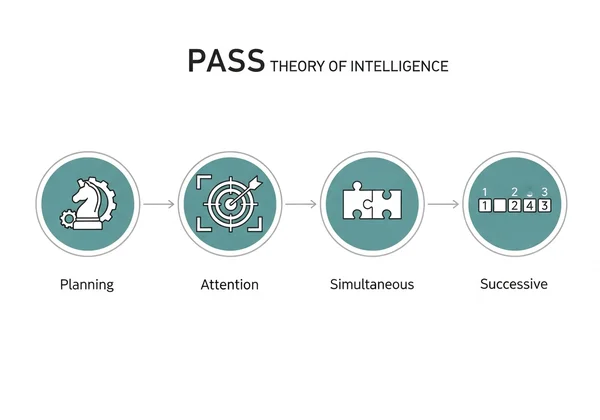
Understanding these pillars helps you pinpoint exactly where a cognitive challenge might lie.
Planning: Strategies for Problem Solving
Planning is the mental process that allows us to determine, select, and use efficient solutions to problems. It involves impulse control, self-monitoring, and retrieval of knowledge. If you feel scattered or struggle to finish complex tasks, the "Planning" domain likely needs evaluation.
Attention: Focus and Selective Concentration
This scale measures the ability to selectively focus on a particular stimulus while ignoring distractions. It is not just about "paying attention"; it involves the resistance to interference. When you feel overwhelmed by a noisy environment or cannot stay on task, your attention processing is likely being taxed.
Simultaneous: Seeing the Big Picture (Spatial)
Simultaneous processing involves integrating separate stimuli into a single whole or group. This is often visual-spatial—like recognizing a face, reading a map, or understanding how a diagram works.
Successive: Sequencing and Memory Order
Successive processing is the ability to work with information in a specific serial order. This capability is critical for grammar, memorizing phone numbers, or following multi-step instructions. If you often lose track of what to do next in a sequence, this is the cognitive domain at play.
CAS vs. Traditional IQ Tests: Key Differences
Many people ask, what is the difference between CAS and IQ test formats? The answer lies in the philosophy of measurement.
Knowledge vs. Process: What You Know vs. How You Think
Traditional IQ tests, such as the Wechsler or Stanford-Binet, often emphasize vocabulary and general knowledge. They measure what you have learned. In contrast, a cognitive assessment system measures potential and process. It evaluates the efficiency of your brain's operating system rather than the files stored on the hard drive.
Cultural Fairness: Reducing Bias in Testing
Because traditional IQ tests rely on vocabulary and cultural knowledge, they can bias results against individuals from different backgrounds. The CAS emphasizes cognitive processes (like matching shapes or recalling number sequences) that require less specific cultural knowledge. This makes it a fairer assessment for diverse populations.
Actionability: From Scores to Intervention
A single IQ score of "100" doesn't tell you how to help a struggling student or an aging parent. However, a CAS profile might reveal high Simultaneous processing but low Planning. This result is actionable: it suggests that the person learns best with visual aids but needs support with organization.
Digital Evolution: From Clinical Kits to Online Screening
Historically, accessing a cognitive assessment system meant scheduling an appointment with a neuropsychologist. You often waited months and paid a significant fee for a paper-and-pencil test. While this remains necessary for formal medical diagnoses, the landscape has evolved.
Accessibility: Breaking the Clinical Barrier
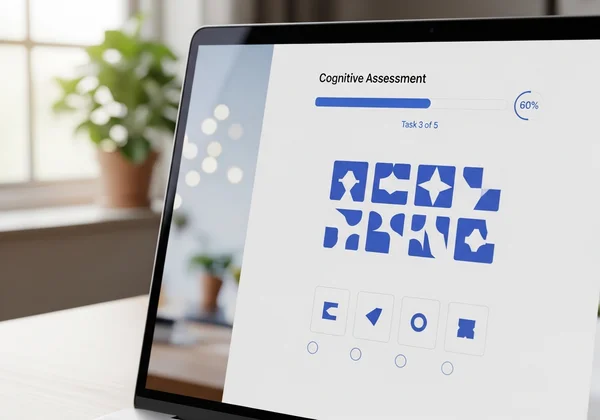
Modern neuroscience has adapted the principles of tests like the CAS2 into digital formats. You no longer need a clinical referral to verify if your memory or focus is slipping. Online cognitive assessment platforms allow individuals to access scientific screening tools instantly.
Speed & Efficiency: Instant Scoring via AI
Traditional manual scoring is prone to human error and takes time. Digital systems utilize Artificial Intelligence (AI) to score tasks in milliseconds. This provides immediate feedback, allowing you to see your results moments after completing the tasks.
Ongoing Monitoring: The Benefit of Baselines
Paper tests are static snapshots. Digital platforms allow for longitudinal tracking. By taking an online cognitive screening annually or quarterly, you establish a baseline. This practice makes it much easier to spot genuine cognitive decline later in life, distinguishing it from normal aging.
Comparison: Clinical vs. Digital Screening
| Feature | Traditional Clinical CAS | Modern Digital Screening |
|---|---|---|
| Primary Goal | Medical Diagnosis / IEP | Health Monitoring / Screening |
| Access | Requires Psychologist | Instant Online Access |
| Cost | High ($500 - $2000+) | Low / Subscription |
| Time | 2-4 Hours | 30-40 Minutes |
| Output | Clinical Report | Actionable Health Insights |
Who Benefits from a Cognitive Assessment System?
While the Das-Naglieri version is famous in schools, the broader concept of cognitive assessment is vital for adults and seniors.
Students & Children: Identifying Learning Styles
For younger populations, these assessments help identify learning disabilities (LD) or ADHD. They help educators understand why a smart child might be failing in class. The cause is often a specific bottleneck in Attention or Successive processing.
Adults & Seniors: Early Detection & Health Monitoring
This represents the fastest-growing user base. Adults concerned about "brain fog," stress-induced cognitive fatigue, or post-COVID cognitive issues use these systems to validate their experiences. For seniors, it provides a sense of control. They can track memory and reasoning skills over time to catch early signs of neurodegenerative changes.
Professionals: Research and Clinical Support
Researchers and clinicians use digital cognitive systems to gather data efficiently. Whether testing the efficacy of a new supplement or monitoring patients recovering from a stroke, digital tools provide standardized, objective data. Subjective questionnaires simply cannot match this precision.
Interpreting Results: What Your Scores Reveal
Receiving a report can feel intimidating. It is important to approach your results with curiosity rather than fear.
Understanding Standard Scores & Percentiles
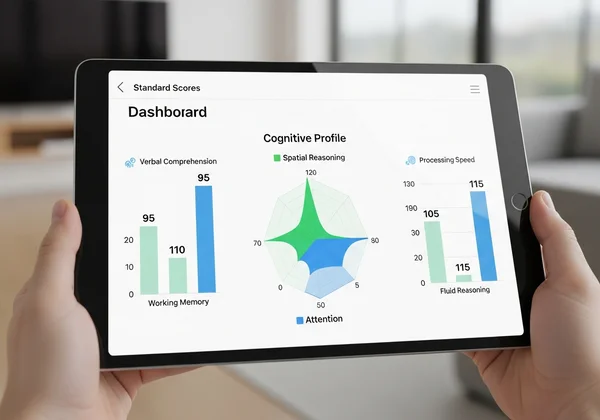
Most systems use "standard scores" where 100 is the average. If you score in the 50th percentile, you are performing exactly as expected for your age group. Scores significantly above or below this indicate relative strengths or weaknesses.
Identifying Cognitive Strengths vs. Weaknesses
It is rare to be "average" across the board. You might find you have superior Simultaneous processing (great at maps, puzzles) but lower Attention. This isn't a failure; it's a blueprint. It tells you that to work effectively, you need to minimize distractions because your brain doesn't filter them out automatically.
Next Steps: When to Seek Professional Help
A digital cognitive assessment is a screening tool, not a diagnostic one.
- Actionable Step: If your report shows a significant drop in a specific area (like Memory) compared to your previous baseline, print your report.
- Medical Consultation: If these scores align with difficulties in your daily life (e.g., leaving the stove on, unable to perform work tasks), take the report to a medical professional for a comprehensive evaluation.
Taking Charge of Your Cognitive Health
For too long, cognitive health was a "black box"—something we only looked at when it was already broken. Today, understanding what is cognitive assessment system technology gives you the power to be proactive.
You don't have to wait for a crisis to understand how your brain works. By understanding the PASS theory and utilizing modern tools, you can identify your unique cognitive profile today. Whether you are managing stress, optimizing your work performance, or watching out for a loved one, having objective data provides peace of mind.
Ready to see how your Planning, Attention, and Memory skills stack up? Start your comprehensive cognitive assessment now to establish your baseline and take control of your brain health.
Frequently Asked Questions
What is the primary purpose of a Cognitive Assessment System?
The primary purpose is to evaluate cognitive functioning—specifically how a person processes information—rather than just measuring what they know. It helps identify cognitive strengths and weaknesses in areas like planning, attention, and memory to guide educational or health interventions.
Can the Cognitive Assessment System diagnose ADHD?
No, a cognitive assessment system (especially an online version) cannot formally diagnose ADHD. However, it can detect patterns—such as significant deficits in Attention or Planning—that are consistent with ADHD. These results can be a valuable starting point to share with a doctor for a formal diagnosis.
How long does a typical cognitive assessment take?
A traditional clinical assessment (like the CAS2) can take 1 to 2 hours to administer plus scoring time. Modern digital cognitive assessments typically take between 30 to 45 minutes to measure a comprehensive range of cognitive skills.
Is the Cognitive Assessment System valid for all cultures?
Systems based on the PASS theory (like the CAS) are generally considered more culturally fair than traditional IQ tests. This is because they rely less on language, vocabulary, and cultural knowledge, and more on abstract cognitive processes that are universal to human brain function.
How often should I take a cognitive assessment?
For healthy adults monitoring their brain health, taking an assessment once every 6 to 12 months is recommended to establish a reliable baseline. This allows you to track changes over time. If you are recovering from an injury or undergoing treatment, more frequent testing may be useful.