Good Cognitive Test Score: What Norms and Benchmarks Mean (With AI Insights)
You’ve just completed a cognitive test. A series of questions and puzzles designed to challenge your mind are now behind you. As you wait for the results, a single, pressing question likely comes to mind: But what does a "good" score on a cognitive test actually mean?
This question is completely normal. We're often taught to think of scores in terms of passing or failing, but when it comes to cognitive health, the answer is far more nuanced and personal. A number on its own tells you very little. The true value lies in understanding the context. It's about what that number means for you, your age, and your life.
Let's break down what your cognitive test score really tells you—no jargon, just straight talk. We'll explore what makes a score meaningful, how benchmarks and norms work, and how modern tools can give you personalized insights that go beyond a simple number. On our platform, we believe understanding your cognitive profile should be an empowering first step toward better brain health, and we’re here to show you how to get that clarity with our scientific cognitive test.

What Exactly Is a "Good" Cognitive Test Score?
The idea of a single "good" score is one of the biggest misconceptions in cognitive assessment. Unlike a school exam, a cognitive test isn't about getting 100%. It’s about creating a snapshot of your brain's performance on a specific day, measuring various skills like memory, attention, and reasoning.
It's More Than Just a Number: Why Context Matters
Imagine someone tells you the temperature is "25." Is that hot or cold? Without context, you can't know. If it's 25° Celsius in London, it's a warm summer day. If it's 25° Fahrenheit in New York, it's freezing. The number is the same, but the context changes everything.
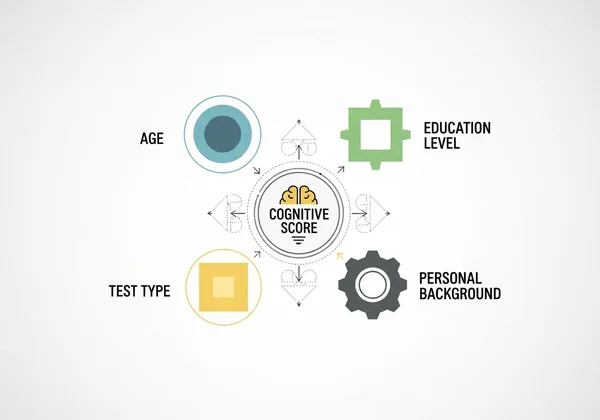
Cognitive scores work the same way. A score is only meaningful when compared to a relevant benchmark. Key contextual factors include:
-
Age: Cognitive abilities naturally change throughout our lives. A typical score for a 30-year-old is very different from a typical score for a 75-year-old.
-
Education Level: Years of formal education can influence how people approach certain types of problems, affecting their performance on specific tasks.
-
Personal Background: Even factors like your profession or daily habits can shape your cognitive strengths.
-
The Test Itself: Different tests measure different skills. A high score on a memory test doesn't necessarily predict your score on a problem-solving test.
Debunking Common Myths About Cognitive Scores
Anxiety around cognitive testing is common, often fueled by myths. Let's clear up a few of them to help you approach your results with confidence.
- Myth 1: A single low score means I have a serious problem.
- Fact: Your cognitive performance can fluctuate. A bad night's sleep, stress, or even feeling unwell can impact your score. A single data point is just that—a point. The real insight often comes from tracking your scores over time.
- Myth 2: A perfect score means I'm a genius and have nothing to worry about.
- Fact: Cognitive tests are designed to measure specific skills, not overall intelligence. A high score is great, but it’s still just a snapshot. The goal is to understand your unique profile of strengths and areas for improvement.
- Myth 3: You can "fail" a cognitive test.
- Fact: Cognitive assessments are not pass/fail exams. They are measurement tools. A lower-than-average score is not a failure; it’s information that can help you and your doctor make informed decisions about your health.
Understanding Cognitive Test Score Norms and Benchmarks
So, if a single number isn’t the whole story, what should you be looking at? The answer lies in norms and benchmarks. These are the standards that provide context and help you understand where your score fits within a larger picture.
Age-Based Cognitive Benchmarks: What's Typical for Your Age?
This is perhaps the most important benchmark. Our processing speed may slow as we age, but other skills, like vocabulary and reasoning, can remain strong or even improve. A good cognitive assessment compares your results to a large group of people in the same age bracket.
For example, forgetting where you placed your keys is a common experience for people of all ages. However, the frequency and context of such memory lapses might be interpreted differently for a 40-year-old versus an 80-year-old. Age-based norms ensure the comparison is fair and relevant. They help distinguish normal age-related changes from patterns that might need a closer look.
The Impact of Education and Background on Your Results
Scientific studies show education builds "cognitive reserve." This helps your brain stay resilient. For example, a literature Ph.D. might shine in verbal tasks, while an engineer excels at spatial reasoning.
Advanced testing platforms, like this cognitive test tool, can use this background information to provide a more refined analysis. This gives you a clearer picture of your performance relative to your unique life experiences.
How Percentiles Help You Understand Your Position
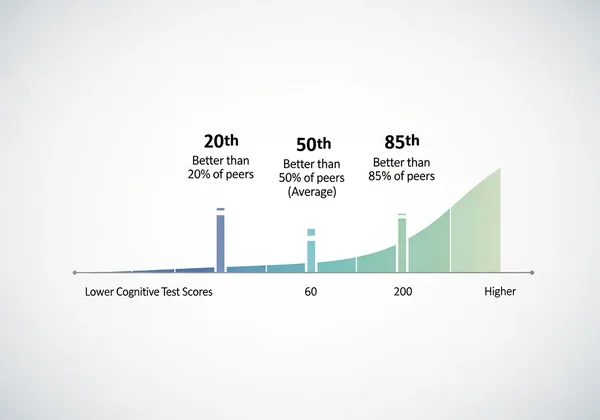
One of the clearest ways to understand your score is through percentiles. A percentile tells you how your score compares to others in the normative group.
- If your score is in the 50th percentile, it means you performed better than 50% of people in your comparison group. This is considered the average.
- If your score is in the 85th percentile, you performed better than 85% of your peers.
- If your score is in the 20th percentile, 80% of your peers scored higher than you on that specific task.
Percentiles shift the focus from a raw score to your relative standing, which is a much more meaningful and less stressful way to interpret your results.
How We Provide Personalized Score Interpretation
Understanding general principles is helpful, but what you really want is to know what your specific scores mean for you. This is where a comprehensive and scientifically designed platform makes all the difference. Our goal isn't just to give you data but to provide you with actionable insights.
A Holistic View: Assessing 22 Core Cognitive Skills
A single, general "cognitive score" can be misleading. Your brain isn't a single machine; it's a network of different functions working together. That’s why our assessment measures 22 distinct cognitive skills across key domains like:
- Memory (e.g., Short-Term, Working Memory)
- Attention (e.g., Divided Attention, Focused Attention)
- Reasoning (e.g., Planning, Processing Speed)
- Coordination (e.g., Hand-Eye Coordination)
This profile reveals your strengths and challenges. Maybe you're great at planning but need help with focused attention. This holistic view is far more useful than any single score. Ready to see your full profile? You can start your test today.
AI-Enhanced Insights: Your Tailored Report Explained
On our platform, we use artificial intelligence (AI) to elevate your report from a simple list of scores to a personalized analysis. When you choose to provide anonymous background details like your age and education, our AI engine integrates this information to provide deeper context.
The AI helps translate complex data into clear, easy-to-understand language. It explains what your performance in each of the 22 skill areas means for your daily life—from remembering a grocery list to staying focused during a conversation. This is the difference between raw data and true understanding.
What a Sample Report Looks Like
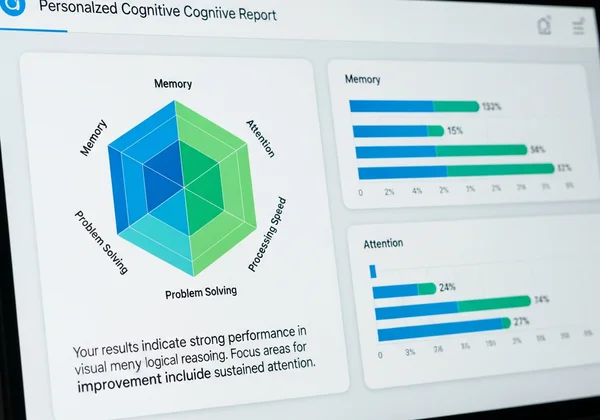
After completing the 30-40 minute assessment, you'll receive an instant summary. Your full report will feature:
- Clear Visuals: Easy-to-read graphs and charts showing your performance in each cognitive domain.
- Percentile Rankings: See exactly where you stand compared to your age group for each of the 22 skills.
- Personalized Explanations: Plain-language descriptions of your cognitive strengths and weaknesses.
- Actionable Advice: General, evidence-based suggestions for supporting your overall brain health.
Our report is designed to empower you with knowledge, not overwhelm you with jargon.
Your Next Steps After Receiving Your Cognitive Test Score
Getting your results isn't the end of the journey—it's the beginning. Here are some constructive ways to use the information from your cognitive assessment.
Tracking Changes Over Time: The Value of Baseline Data
Your first test establishes a valuable baseline. Think of it as a starting point on your cognitive health map. By taking the test periodically (e.g., every 6 to 12 months), you can monitor for any significant changes.
This longitudinal tracking is one of the most powerful ways to proactively manage your brain health. It reveals trends for a fuller picture than one test. Easily track your cognition to build your history.
When to Consult a Professional About Your Cognitive Scores
It's crucial to remember that screening tools like ours are powerful resources, but they are not a substitute for a professional medical diagnosis.
You should consider speaking with a doctor, neuropsychologist, or other qualified healthcare professional if:
- Your test results show a significant or unexpected decline.
- You or your family members are concerned about noticeable changes in your daily functioning (e.g., memory, problem-solving, or mood).
- You want to discuss your results and create a formal plan for your cognitive health.
Bring your report to the appointment; it can serve as an excellent, data-informed starting point for a productive conversation.
Lifestyle Strategies for Supporting Overall Brain Health
Regardless of your scores, everyone can benefit from adopting a brain-healthy lifestyle. Research consistently shows that certain habits can support and protect cognitive function. These include:
- Regular Physical Activity: Exercise increases blood flow to the brain.
- A Balanced Diet: Foods rich in omega-3s, antioxidants, and vitamins are beneficial.
- Quality Sleep: Sleep is essential for memory consolidation and clearing toxins from the brain.
- Mental Stimulation: Keep learning new things, solving puzzles, or engaging in hobbies.
- Social Connection: Strong social ties are linked to better cognitive outcomes.
Ready to Make Sense of Your Scores?
Think of your cognitive test results as a map, not a verdict. With the right context—like age norms and your full skill profile—you'll see clear paths to stronger brain health. Understanding your results through the lens of norms, percentiles, and a holistic skill profile transforms confusion into clarity. It empowers you to take proactive steps, track your health over time, and have more informed conversations with healthcare providers.
Are you ready to gain a deeper understanding of your own cognitive landscape? Our scientifically designed assessment is waiting for you. It's comprehensive, easy to use, and provides the personalized, AI-enhanced insights you need to take control of your brain health.
Discover your cognitive profile today and take the first step toward a clearer future.
Frequently Asked Questions About Cognitive Test Scores
What is a good cognitive test score?
A "good" score isn't a single number. It becomes meaningful only when interpreted relative to norms for your age and educational background. Generally, performing around the 50th percentile is considered average for your group, while higher percentiles indicate stronger performance in a specific area.
How difficult is a cognitive test?
A well-designed cognitive test should be challenging. To accurately measure your abilities, the tasks need to push your limits. Some sections may feel easy, while others will require more effort. It's not a pass/fail exam, so don't be discouraged if you find some questions difficult.
What if you fail a cognitive test?
You cannot "fail" a cognitive assessment. It is a measurement tool, not a test with a passing grade. A score that is lower than you expected is simply a data point. It can serve as a signal to pay closer attention to your brain health, adopt healthier lifestyle habits, or start a conversation with a medical professional.
Can I take a cognitive test online for free?
Yes, platforms like ours offer a comprehensive assessment to help you understand your cognitive function. You can take our free test and receive an immediate summary of your performance, with the option to get a more detailed, AI-enhanced report.
How is our assessment different from free brain games?
Brain games are primarily designed for entertainment and practice. While they can be stimulating, they aren't standardized tools for measuring cognitive function. Our assessment is a scientifically validated tool based on established neuropsychological principles. Its purpose is to provide a reliable and comprehensive measurement of 22 core cognitive skills, not just to train one or two of them.