Medicare Cognitive Test: Questions, Coverage, and What to Expect in 2026
If you searched for "medicare cognitive test," you are probably trying to understand what happens during a Medicare wellness visit, what questions might be asked, and whether the test is required. The short answer is that Medicare wellness visits include a check for possible cognitive impairment, but there is no single national test with one fixed answer key. A clinician may use observation, patient or family concerns, brief memory tasks, a clock drawing task, or another validated tool. If you want a broader, educational baseline outside a medical visit, an online cognitive assessment can help you reflect on cognitive strengths and challenges without replacing professional care.

What the Medicare Cognitive Test Is
The Medicare cognitive test is not one special exam owned by Medicare. In everyday language, people use the phrase to describe the cognitive impairment check that is part of the Medicare Annual Wellness Visit, or a longer cognitive assessment and care planning visit when more review is needed.
During a wellness visit, the provider is expected to look for possible cognitive impairment. That can include direct observation, questions about daily function, reports from a family member or caregiver, and sometimes a brief screening tool. The goal is to notice whether memory, attention, judgment, language, planning, or everyday problem solving may need closer review.
This is different from a full neuropsychological evaluation. A short screening task can raise a useful signal, but it cannot tell the whole story by itself. Sleep, hearing, vision, medications, depression, anxiety, pain, infection, and stress can all affect performance. That is why a responsible provider looks at the person, the history, and the context rather than one answer alone.
Is the Medicare Cognitive Test Mandatory?
For patients, a Medicare cognitive test is not best understood as a forced exam. Medicare rules include cognitive impairment detection as part of the Annual Wellness Visit, so providers may ask questions or use a brief tool to complete that visit properly. But Medicare does not make every beneficiary complete an Annual Wellness Visit, and it does not require one specific memory test for everyone.
If you are uncomfortable, you can ask what the clinic is doing, why it is being done, how the result will be used, and whether you can pause or decline a specific task. The practical answer may depend on the clinic workflow, your Medicare plan, and whether the provider is trying to evaluate a concern that came up during the visit. A calm question such as "Is this part of my wellness visit, and will it affect my bill?" is reasonable.
The most important point is consent and clarity. A cognitive check should help start a useful conversation, not make you feel trapped. If a family member is attending the visit, you can also decide whether you want that person to help answer questions about daily changes.
Medicare Cognitive Test Questions You May See in 2026
There is no universal list of Medicare cognitive test questions for 2026, 2025, or 2024. Medicare allows clinicians to assess cognitive function in more than one way. Some clinics use the Mini-Cog, some use another brief screening instrument, and some combine observations with a longer conversation.
Still, several task types are common in senior cognitive screening. They are designed to sample different mental abilities, not to judge intelligence.
Three-Word Recall
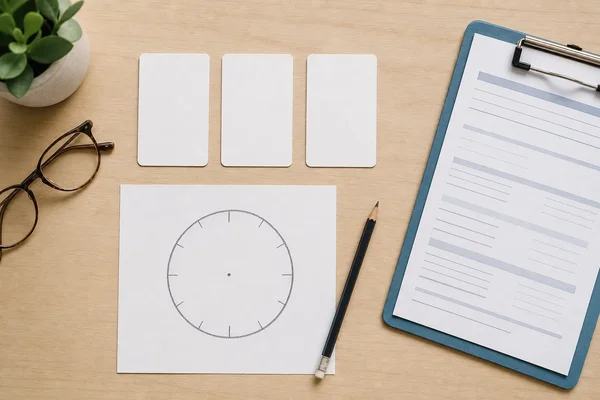
Many people ask, "What are the three words for the Medicare memory test?" There is no fixed set of three words that every Medicare patient receives. In a three-word recall task, the clinician says three unrelated words, asks the patient to repeat them, then asks for the words again after a short delay.
The purpose is to look at immediate registration and delayed recall. Trying to memorize a rumored answer list is not useful because the words can vary and the task is meant to reflect how memory works in the moment.
Clock Drawing
In a clock drawing task, the patient may be asked to draw a clock face and place the hands at a specific time. This can give the provider a quick view of planning, visual organization, number placement, attention, and instruction-following.
People sometimes worry that poor handwriting will make them "fail." Usually, the provider is looking at the structure of the task, not artistic skill. Tremor, vision problems, arthritis, or low familiarity with analog clocks should be mentioned because they can affect the drawing.
Orientation, Attention, and Daily Function
Other Medicare memory test questions may be conversational. A provider may ask about the date, recent events, medication management, getting lost, missed bills, falls, mood, sleep, or whether family members have noticed changes. Some brief tools include counting backward, naming items, following a multi-step instruction, or matching symbols.
For a cognitive testing resource outside the clinic, the value is different: it can help you notice patterns across attention, memory, and processing style, but it should be treated as educational information rather than a medical decision.
Does Medicare Cover Cognitive Testing?
Medicare coverage depends on which service is being provided. The cognitive check inside an Annual Wellness Visit is part of that wellness visit. A separate cognitive assessment and care plan visit is covered under Medicare Part B when a health care provider needs to fully review cognitive function and develop a care plan.
For that separate cognitive assessment and care plan service, Medicare Part B cost sharing generally applies. After the Part B deductible, the beneficiary typically pays 20% of the Medicare-approved amount. Actual costs can vary based on other insurance, whether the provider accepts assignment, the facility type, where the visit happens, and whether extra services are ordered.

A care plan visit may include a medical history review, medication review, discussion of social supports, advance care planning, referrals if needed, and information about community resources. It is more than a quick memory question. It is meant to connect cognitive concerns with practical next steps.
If a clinic recommends labs, imaging, a specialist referral, or a problem-focused visit on the same day, ask how those services will be billed. The wellness visit and a separate medically necessary service can have different cost rules.
Is There a Medicare Cognitive Assessment Form or PDF?
Searches for "medicare cognitive assessment form" and "medicare cognitive test questions 2026 pdf" often lead to confusion. There is not one official public PDF that contains every Medicare cognitive test question with answers. Medicare policy describes required elements and covered services, while clinicians choose appropriate tools and document the result in the medical record.
Some clinics use standardized forms. Others use electronic health record templates. Some use named tools such as Mini-Cog or other brief cognitive screeners. The form is usually for documentation and clinical workflow, not a take-home answer sheet.
If you want paperwork before the appointment, ask the clinic what to bring instead of searching for answers. Useful items include a medication list, hearing aids or glasses, a family health history, notes about recent memory or attention changes, and examples of daily tasks that have become harder.
How to Prepare Without Memorizing Answers
The best preparation is practical, not test-prep style. A Medicare wellness cognitive check is meant to capture how you are doing, so memorizing sample answers can make the visit less helpful.

Before the visit, write down:
- Memory, attention, language, or planning changes you have noticed
- When the changes started and whether they are getting better, worse, or staying about the same
- Medication or supplement changes
- Sleep, mood, hearing, vision, pain, or major life stressors
- Safety concerns, such as falls, driving confusion, missed bills, or trouble managing meals
- Questions about cost, privacy, and follow-up
If you are a caregiver, focus on specific examples rather than labels. "She forgot the stove twice this month" is more useful than "her memory is bad." If you are the patient, bring your own examples too. Cognitive health conversations work best when the person being assessed remains central to the discussion.
What Happens After a Concerning Result?
A concerning screening result does not automatically mean a serious condition is present. It means the provider may want more information. The next step might be repeating the task, reviewing medications, checking sleep and mood, ordering lab work, addressing hearing or vision, scheduling a longer visit, or referring to a specialist.
It is also possible for a brief check to be normal even when a person still feels something has changed. If you or a caregiver continue to notice problems, say so. Real-world function matters. A short office task is only one piece of a larger picture.
For people who do receive a care plan, ask for plain-language next steps. Good questions include:
- What did this result suggest?
- What else could affect my performance?
- What should we watch over the next few months?
- Should medication, sleep, mood, hearing, or vision be reviewed?
- When should I return, and who should I contact if symptoms change?
Using Cognitive Insight Beyond the Medicare Visit
The Medicare cognitive test conversation is useful because it puts brain health into routine preventive care. But it should not be the only moment when you think about memory, attention, and daily function. Many people benefit from tracking patterns over time, especially after medication changes, sleep changes, stress, illness, or a major life transition.
A structured brain health snapshot can support that reflection by helping you organize cognitive strengths and challenges in a clear, non-emergency way. Treat the result as a learning tool and conversation starter. If you have new, worsening, or safety-related concerns, bring them to a qualified health professional.
FAQ
What are the three words for the Medicare memory test?
There is no single set of three words used for every Medicare memory test. A provider may choose words from a validated tool or clinic protocol. The task usually checks whether you can repeat and later recall three unrelated words.
What questions are on a cognitive test for seniors?
Common questions or tasks may involve three-word recall, clock drawing, date or place orientation, counting, following instructions, naming objects, and discussing changes in daily activities. The exact tool can vary by clinic.
Will Medicare pay for cognitive testing?
Medicare includes cognitive impairment detection in the Annual Wellness Visit. Medicare Part B also covers a separate cognitive assessment and care plan visit when appropriate, with Part B deductible and coinsurance rules generally applying to that separate service.
Can I refuse a Medicare cognitive test?
You can ask what the task is, why it is being used, how the result will be documented, and whether you can decline or pause. Medicare does not force every beneficiary to complete an Annual Wellness Visit, but clinic policies and medical concerns can affect how the visit proceeds.
Are Medicare cognitive test questions the same in 2026 and 2025?
There is no universal yearly question list. The basic Medicare wellness requirement to check for possible cognitive impairment has remained consistent, but clinics may use different tools, forms, and workflows.
Is a Medicare cognitive test the same as an online cognitive test?
No. A Medicare cognitive check happens in a health care setting and may affect medical follow-up. An online cognitive test is best used for education, self-reflection, and tracking patterns to discuss with a professional when appropriate.