Memory Tests — Types, How They Work, and What Your Results Mean
Memory tests are one of the most common ways to understand how well your brain stores and retrieves information. Whether you are noticing small lapses in daily recall, supporting a loved one through cognitive changes, or simply curious about your mental sharpness, understanding memory tests can help you take a meaningful next step. This guide walks you through the main types of memory tests, what they actually measure, how testing works in both clinical and online settings, and what to do with your results. You will also find practical tips for self-assessment and a clear checklist for knowing when professional evaluation makes sense.
What Are Memory Tests and Why Do They Matter?
Memory tests are structured assessments designed to evaluate how effectively you encode, store, and recall information. They range from quick screening tools a doctor uses during a routine checkup to comprehensive evaluations performed by neuropsychologists.
Who Benefits From Memory Testing?
Almost anyone can benefit from a memory test. You may want to explore testing if you:
- Frequently forget recent conversations or appointments
- Notice difficulty following instructions or multistep tasks
- Feel that your memory has declined compared to a few years ago
- Want to establish a cognitive baseline for future comparison
- Are supporting a family member who shows signs of memory changes
Memory tests also serve clinical and research purposes. Healthcare professionals use them to detect early signs of mild cognitive impairment, track cognitive changes over time, and evaluate the effectiveness of treatments.
What Do Memory Tests Actually Measure?
A memory test typically evaluates several cognitive domains, not just recall. Core areas include:
- Encoding — how well you absorb new information
- Storage — how your brain holds that information over time
- Retrieval — how effectively you access stored memories when needed
Some tests focus on a single memory type, while others provide a broader cognitive profile. Understanding what each test measures helps you choose the right one for your goals.
What Are the Common Types of Memory Tests?
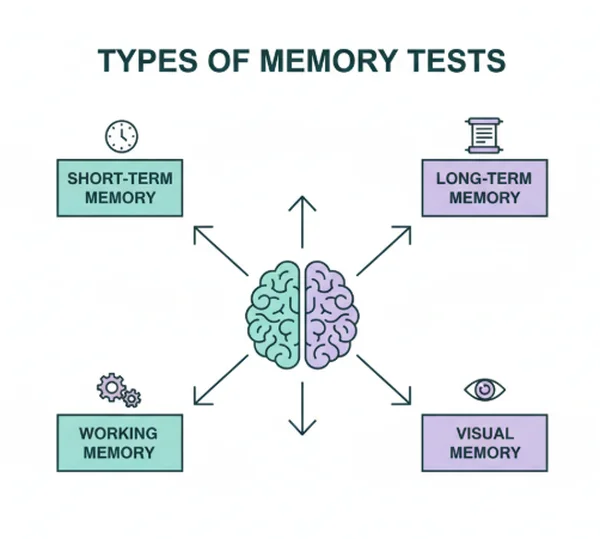
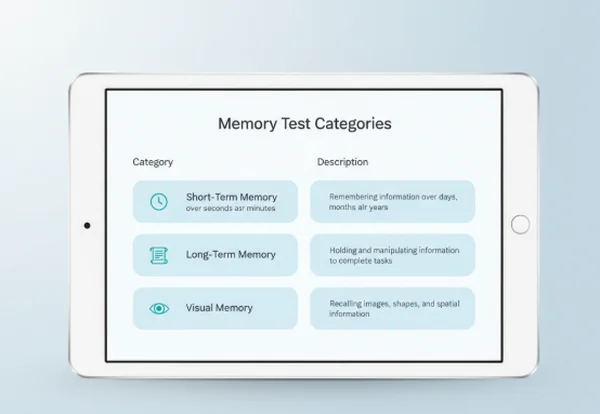
Memory tests fall into several categories based on the type of memory they assess. Here is a practical breakdown of the most widely used approaches.
Short-Term Memory Tests
Short-term memory tests measure your ability to hold small amounts of information for brief periods. Common examples include:
- Digit Span Test — You hear a sequence of numbers and repeat them forward or backward. The sequence gets longer as you progress.
- Word List Immediate Recall — You listen to a short list of words and repeat as many as you can right after hearing them.
- Three-Word Recall — Often used as part of the Mini-Cog screening, this task asks you to repeat three unrelated words after a brief delay.
These tests help identify whether your brain can effectively capture and briefly hold new information.
Long-Term Memory Tests
Long-term memory tests introduce a delay between learning and recall, usually ranging from several minutes to hours. Examples include:
- Delayed Word List Recall — After studying a word list, you try to recall items 15 to 30 minutes later.
- Story Recall — You listen to a short narrative and retell key details after a waiting period.
- Recognition Tasks — Instead of free recall, you identify previously learned items from a group of options.
These tests reveal how well information moves from temporary storage into more permanent memory.
Working Memory Tests
Working memory tests go beyond simple recall. They require you to hold information in mind while simultaneously processing it. For instance:
- N-Back Tasks — You monitor a stream of items and indicate when the current item matches one presented a set number of steps earlier.
- Complex Span Tasks — You remember a sequence of items while also solving simple math problems between each one.
Working memory is essential for reading comprehension, problem-solving, and following multistep instructions. If you feel overwhelmed when juggling several pieces of information at once, a working memory assessment may offer useful insight.
Visual Memory Tests
Visual memory tests evaluate your ability to recall images, patterns, or spatial information. These are especially useful for detecting early cognitive changes because visual processing is often affected before verbal skills decline.
- Pattern Recognition Tasks — You study a set of images and identify them in a later sequence.
- Spatial Sequence Tests — You observe a sequence of highlighted locations on a grid and reproduce the pattern from memory.
How Do Clinical Memory Screening Tools Work?
When a healthcare professional evaluates your memory, they typically begin with a standardized screening tool. Here are the most common clinical memory tests and what each one involves.
MMSE — Mini-Mental State Examination
The MMSE is a 30-point assessment that evaluates orientation, attention, memory, language, and visuospatial skills. It takes roughly 10 minutes and is widely used in primary care. However, the MMSE may not catch subtle early-stage cognitive changes, which is why many professionals now prefer the MoCA.
MoCA — Montreal Cognitive Assessment
The MoCA is a more sensitive screening tool designed specifically to detect mild cognitive impairment. It assesses attention, concentration, executive function, memory, language, visuospatial ability, abstraction, and orientation. Most people complete it in about 10 to 15 minutes.
Mini-Cog
The Mini-Cog combines a three-word recall task with a clock-drawing test. Because it takes only about three minutes, it is especially practical for primary care settings and initial screenings.
SAGE — Self-Administered Gerocognitive Exam
The SAGE test is a 12-question form developed at Ohio State University. You can complete it at home with a pen and paper in about 10 to 15 minutes. While it does not replace a professional diagnosis, it can serve as a useful starting point for conversations with your doctor.
How Can You Test Your Memory at Home?
You do not always need a clinical appointment to get a sense of your memory health. Several approaches allow you to explore memory testing on your own terms.
Online Memory Tests
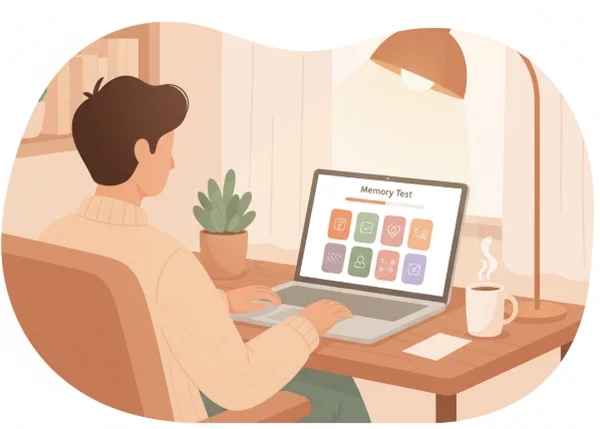
Online memory tests offer a convenient starting point for self-assessment. Many platforms provide free screenings that evaluate short-term recall, pattern recognition, or reaction time. Keep these points in mind:
- Online tests are not diagnostic tools. They offer a snapshot, not a clinical conclusion.
- Results can be influenced by factors like sleep quality, stress, and screen fatigue.
- If an online test raises concerns, follow up with a healthcare professional for a comprehensive evaluation.
When choosing an online test, look for platforms backed by neuroscience research rather than casual quiz-style tools. A scientifically grounded assessment provides more meaningful data about your cognitive profile.
Simple Self-Checks You Can Try Today
Between formal tests, these quick exercises can help you notice patterns in your own memory:
- Word list practice — Write down 10 random words, study them for one minute, then try to recall them after 15 minutes.
- Story retelling — Read a short news article, put it away, and summarize the key points from memory 30 minutes later.
- Reverse sequence — Pick a five-digit number and try to say it backward without writing it down.
These are not substitutes for professional testing. However, they can help you become more aware of your own cognitive patterns over time.
What Factors Can Affect Your Memory Test Results?
A single memory test captures a moment in time, not a permanent truth about your brain. Many everyday factors can influence your performance.
Stress and Sleep
Chronic stress raises cortisol levels, which can temporarily impair memory consolidation and retrieval. Similarly, even one night of poor sleep can significantly reduce working memory capacity. If you are testing during a stressful period, your results may not reflect your typical cognitive ability.
Medications and Health Conditions
Certain medications — including antihistamines, sleep aids, and some blood pressure drugs — can affect memory. Health conditions like thyroid disorders, vitamin B12 deficiency, and depression are also common but treatable causes of memory changes. Your doctor can help rule out these reversible factors before attributing changes to cognitive decline.
Test Familiarity and Anxiety
Feeling anxious about a test can reduce your performance, especially on timed tasks. Likewise, people who have taken similar tests before may perform slightly better simply because the format feels familiar. Neither scenario reflects a true change in underlying memory ability.
How to Know When Memory Changes Need Professional Attention
Not every forgotten name or misplaced key signals a problem. However, certain patterns deserve attention.
A Practical Checklist for Deciding When to See a Doctor
Consider seeking a professional memory evaluation if you notice:
- ✅ Memory lapses that are increasing in frequency over weeks or months
- ✅ Difficulty completing familiar tasks you used to handle easily
- ✅ Getting lost in familiar places or confused about dates and sequences
- ✅ Loved ones pointing out memory changes you may not notice yourself
- ✅ Memory issues that interfere with daily functioning, work, or relationships
If two or more of these apply, a conversation with your healthcare provider is a worthwhile next step. Early assessment does not mean a diagnosis. Often, it brings reassurance or helps identify treatable causes.
How a Comprehensive Cognitive Assessment Can Help You Understand Your Results
When you receive your memory test results — whether from a clinical screening or an online platform — the numbers alone rarely tell the full story. A comprehensive cognitive assessment places your scores in context by comparing them against norms for your age, education level, and background.
At CognitiveTest.me, you can explore a scientifically grounded cognitive assessment that evaluates 22 core cognitive skills, including multiple dimensions of memory. The platform uses AI-enhanced analysis to generate a personalized report that highlights your cognitive strengths and areas for growth — without making diagnostic claims. This kind of structured self-reflection can help you organize your observations, prepare for a conversation with a healthcare professional, or simply understand your cognitive profile more clearly.
This tool is designed for educational and self-understanding purposes. It does not replace clinical evaluation or professional diagnosis. If you have concerns about cognitive decline, please consult a qualified healthcare provider.
Key Takeaways for Anyone Exploring Memory Tests
Understanding memory tests gives you a clearer picture of your cognitive health and helps you make informed decisions about next steps.
- Memory tests measure how well you encode, store, and retrieve information across different domains.
- Common clinical tools include the MMSE, MoCA, Mini-Cog, and SAGE — each with different strengths and ideal use cases.
- Online tests offer a convenient starting point but are not diagnostic. Always follow up with a professional if concerns arise.
- Factors like stress, sleep, and medication can significantly influence results. One test is a snapshot, not a verdict.
- Knowing when to seek professional evaluation is just as important as the test itself. Use the checklist above to guide your decision.
If you want a deeper look at how your memory fits within your broader cognitive profile, explore the comprehensive cognitive assessment at CognitiveTest.me. It is a practical, low-pressure way to begin understanding your brain health.
Frequently Asked Questions
What is the 3-word memory test?
The 3-word memory test is a brief screening exercise included in tools like the Mini-Cog. You repeat three unrelated words, complete a short task (usually clock drawing), then recall the words. It helps detect possible memory concerns quickly, though it is not a standalone diagnosis.
Are online memory tests accurate?
Online memory tests can offer helpful initial insights into cognitive patterns, but they are not clinically diagnostic. Factors like internet speed, distractions, and test design affect accuracy. Use them as a starting point and consult a professional for a thorough evaluation.
How can I test my memory at home?
You can try simple exercises like word list recall, story retelling, or reverse number sequences. Free online cognitive screening tools also allow self-assessment. These methods help you notice patterns but should not replace professional testing if you have persistent concerns.
What is the difference between short-term and long-term memory tests?
Short-term memory tests measure immediate recall — repeating information right after hearing it. Long-term memory tests add a delay (minutes to hours) before asking you to recall the same material. Both types reveal different aspects of how your brain processes and retains information.
Can stress affect memory test results?
Yes. Stress raises cortisol, which can impair memory consolidation and retrieval. Sleep deprivation, anxiety, and medications may also lower performance. If you scored poorly during a stressful period, consider retesting under calmer conditions before drawing conclusions.
When should you see a doctor about memory concerns?
Consider scheduling an appointment if memory lapses increase in frequency, interfere with daily activities, or are noticed by others around you. Early evaluation often identifies treatable causes and provides peace of mind rather than a diagnosis. A comprehensive cognitive test can help you prepare for that conversation.
What does the SAGE memory test involve?
SAGE (Self-Administered Gerocognitive Exam) is a free 12-question pen-and-paper test developed at Ohio State University. It takes about 10 to 15 minutes and assesses orientation, memory, problem-solving, and language. Results should be reviewed by a healthcare provider for proper interpretation.
What is the difference between the MMSE and MoCA?
The MMSE is a widely used 30-point screening for cognitive impairment, but it may miss early-stage changes. The MoCA was designed specifically to detect mild cognitive impairment and tests additional domains like executive function and abstraction, making it generally more sensitive for early detection.