Sample Cognitive Tests for Seniors With Questions and Practical Examples
Sample cognitive tests for seniors can make an unfamiliar appointment feel less mysterious. They show the kinds of tasks an older adult may be asked to try: remembering words, drawing a clock, following instructions, naming objects, solving simple problems, and explaining everyday situations. A sample is not a medical answer sheet, and it should not be used to label a person. It is a way to understand what cognitive screening looks like, prepare calmly, and know when a fuller conversation with a professional may be useful. For people who want a broader baseline, an online cognitive assessment for everyday brain health can also support reflection between routine care visits.

What a Cognitive Test Sample Can and Cannot Tell You
A cognitive test sample is a preview, not a final judgment. It can show which mental skills are commonly checked and why a clinician or screening tool might ask certain questions. For seniors, these tasks often look simple on the surface, but each one is meant to touch a specific cognitive domain such as attention, memory, language, visuospatial skill, orientation, reasoning, or executive function.
The most helpful way to use a sample is to reduce uncertainty. A family member may want to know why a clock drawing appears in many screens. An older adult may want to understand whether word recall is about intelligence or short-term memory. A caregiver may want to see how a brief screen differs from a long neuropsychological evaluation.
What a sample cannot do is identify the cause of a change. A low score, a missed word, or trouble with one task can be influenced by hearing, vision, anxiety, sleep, medication effects, pain, depression, education, language, and the testing setting. A professional evaluation may also include medical history, medication review, functional history, labs, imaging, mood screening, and input from someone who knows the person well.
Common Question Types in Cognitive Tests for Seniors
Most cognitive test samples for seniors combine several task types because cognition is not one single skill. A person may have strong language and reasoning while finding delayed recall more difficult, or may remember words well but struggle with divided attention. A broader screen helps create a more balanced picture.
Orientation Questions
Orientation questions ask about basic context: the current date, day of the week, month, season, city, building, or reason for the visit. These questions are not meant to embarrass anyone. They check whether a person can connect memory, attention, and environmental awareness in the moment.
Memory Recall Tasks
Memory tasks often ask the person to repeat a short list of words, wait while other tasks are completed, and then recall the words later. A three-word recall task is common in brief screens. A five-word memory task may add more challenge by testing how well new information is encoded and retrieved after a delay.
Attention and Working Memory Tasks
Attention tasks may ask someone to spell a short word backward, count backward by a set number, repeat numbers in order, or repeat numbers in reverse order. These tasks look school-like, but the purpose is usually to test focus, mental tracking, and working memory rather than academic knowledge.
Language and Naming Tasks
Language tasks may ask the person to name common objects, repeat a phrase, follow a spoken instruction, write a sentence, read a short sentence, or name as many animals as possible in one minute. These tasks can highlight word-finding, comprehension, fluency, and expressive language.
Visuospatial and Clock-Drawing Tasks
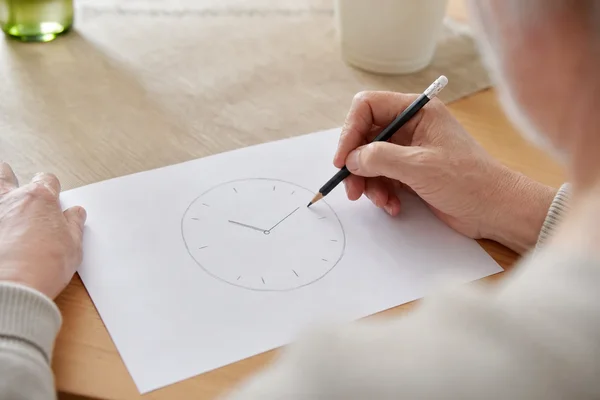
Clock drawing is common because it brings together several skills at once. The person has to understand the instruction, plan the circle, place numbers in the right order and spacing, and set the hands to a requested time. Copying a shape or drawing intersecting figures can also test visual organization and motor planning.
Executive Function and Judgment Tasks
Executive function tasks look at planning, flexibility, inhibition, and practical reasoning. A sample question might ask what the person would do if they smelled smoke in the kitchen or found a stamped, addressed envelope on the sidewalk. In a broader tool, a 22-skill cognitive profile may also separate attention, memory, executive function, and related skills more clearly than a very brief screen.

Sample Cognitive Test Questions for Seniors
The examples below are for education only. They are not a scoring key, and they should not be treated as a substitute for a validated test form. Many real tools use strict wording, timing, scoring rules, and professional interpretation.
1. Three-Word Recall
The tester says three unrelated words, such as "rose," "clock," and "river." The person repeats them immediately. After a few minutes and other tasks, the tester asks for the same three words again.
This checks immediate registration and delayed recall. A correct response would be recalling the same words, but the meaning depends on the exact tool, timing, cues, and total pattern of results.
2. Five-Word Memory Task
The tester presents five everyday words, asks the person to repeat them, and later asks for them again. Some versions include category cues, such as asking for "the fruit" or "the piece of furniture."
This checks whether cues help retrieval. It can be more informative than simply marking a word as remembered or not remembered.
3. Clock Drawing
The person is asked to draw a clock, place all the numbers, and set the hands to a specific time, such as 10 past 11.
This checks planning, spatial organization, number placement, comprehension, and executive control. A complete answer usually has a closed circle, numbers in a reasonable order and position, and hands showing the requested time.
4. Orientation
The tester may ask: What is today's date? What month is it? What city are we in? What season is it?
These questions check awareness of time and place. Missing one item is not enough to explain a person's cognitive health, especially if stress, travel, hospitalization, or sensory problems are involved.
5. Attention and Calculation
The person may be asked to count backward from 100 by sevens, spell a five-letter word backward, or repeat a number sequence in reverse order.
These tasks check sustained attention and mental manipulation. They can be affected by education, comfort with numbers, anxiety, and hearing clarity.
6. Naming and Language
The tester may point to a watch or pencil and ask the person to name it. They may also ask the person to repeat a phrase, follow a three-step instruction, or list words in a category.
These tasks check naming, comprehension, repetition, and verbal fluency. Word-finding changes can have many causes, so context matters.
7. Similarities and Reasoning
The tester may ask: How are a train and a bicycle alike? How are an apple and an orange alike?
These questions look at abstract reasoning. A concrete answer may still be understandable, but a more abstract answer, such as "they are both forms of transportation" or "they are both fruits," usually shows the intended kind of reasoning.
8. Everyday Judgment
The tester may ask: What would you do if you saw smoke coming from a neighbor's window? What would you do if you found a wallet in a store?
These questions check practical judgment, safety awareness, and problem-solving. The best responses usually include safe, socially appropriate steps.
How Common Senior Screening Tools Differ
Different tools are built for different settings. A very brief screen may be useful in a primary care visit, while a longer tool may provide more detail. Some are completed by the older adult, some by a trained staff member, and some include caregiver input.
The Mini-Cog is brief and combines word recall with clock drawing. The MMSE is a 30-point screen that includes orientation, memory, attention, language, and visuospatial tasks. The MoCA is also a 30-point tool and is often described as covering a wider range of skills, including executive function and abstraction. SAGE is a self-administered paper-and-pencil screen that many people complete at home and bring to a physician for scoring. The Five-Minute Cognitive Test was studied as a short screen covering episodic memory, language fluency, time orientation, visuospatial function, and executive function.
No single tool is always best for every person. Language, education, culture, sensory ability, test access, and the reason for screening all matter. For this reason, a cognitive test sample for seniors is most useful when it helps a person ask better questions: Which skills are being checked? Who scores the tool? What follow-up is appropriate? How will the result be interpreted alongside daily functioning?
How to Use Sample Questions at Home Without Overreading Them
Families often search for a free cognitive test with answers because they want clarity quickly. That is understandable, but answer sheets can create false confidence. Many cognitive screens are validated as complete instruments, not as casual quizzes. Timing, allowed prompts, scoring rules, and the testing environment can all change the meaning of a result.
A safer home approach is to use samples for preparation and observation, not scoring. Read through the task types together. Make sure glasses, hearing aids, lighting, and a quiet setting are available. Notice whether the person seems confused by instructions, anxious, tired, or frustrated. Write down practical examples from daily life, such as missed appointments, repeated questions, medication mix-ups, navigation problems, or new difficulty with finances.
If you do try a sample memory task, avoid repeating it often. Practice effects can make a person look better at the task without showing a true change in everyday cognition. Repeated testing is most useful when the same validated tool is used under similar conditions and interpreted with the person's broader history.

When Seniors Should Discuss Cognitive Changes With a Professional
Consider a professional conversation when memory or thinking changes interfere with daily life, safety, independence, finances, medication routines, driving, cooking, or communication. It is also worth seeking help when family members notice changes that the person does not, or when mood, sleep, hearing, vision, pain, or medication changes may be contributing.
Professional follow-up does not always mean something serious is happening. It can help identify reversible contributors, clarify what is normal for the person, and decide whether more testing is appropriate. A cognitive screen is one part of that process, not the whole answer.
For urgent changes, such as sudden confusion, new weakness, severe headache, speech trouble, chest pain, or a fall with head injury, seek immediate medical care. Sudden changes are different from gradual forgetfulness and should not be handled with an at-home sample test.
A Practical Next Step for Seniors and Caregivers
If you are comparing sample cognitive tests for seniors, focus less on finding a perfect answer sheet and more on building a useful record. Note which skills felt easy, which felt challenging, what conditions might have affected performance, and whether the same changes show up in daily life. Bring those observations to a healthcare professional if there are concerns.
For ongoing self-reflection, a structured cognitive baseline for older adults can help organize attention, memory, reasoning, and executive-function observations in a calmer way. Use it as an educational reference point, not as a final medical conclusion. The best next step is the one that turns vague worry into clear, respectful information.
FAQ
What questions are on a cognitive test for seniors?
Common questions ask about date and location, word recall, naming objects, following directions, drawing a clock, spelling or counting backward, explaining similarities, and responding to everyday judgment scenarios. The exact questions depend on the tool and setting.
What is the 12 question dementia test?
People often use that phrase for brief cognitive screens they find online, but there is no single universal 12-question test that applies to every older adult. Some self-administered tools include a small set of tasks across memory, language, reasoning, and visual skills. Results should be reviewed in context by a qualified professional.
What are the three words to remember for a cognitive test?
There is no fixed set of three words. A tester may use three unrelated everyday words, such as a flower, object, and place. The important part is whether the person can repeat them immediately and recall them after a short delay under the tool's instructions.
What is the 5 word memory test for seniors?
A five-word memory task asks a person to learn five words and recall them later, sometimes with category cues. It checks learning, delayed recall, and whether cues improve retrieval. It is one piece of a broader cognitive picture.
Can I use a free cognitive test with answers at home?
You can use sample questions to understand the format, but be careful with answer sheets. Many tools need standardized scoring and interpretation. If results raise concern, bring the completed form or your observations to a healthcare professional.
Is a cognitive test for seniors online useful?
An online cognitive test can be useful for education, self-reflection, and tracking a personal baseline over time. It should be treated as supportive information, especially for changes that affect daily life. Medical concerns need professional review.
How often should a senior repeat a cognitive test?
That depends on the reason for testing. Some people repeat a baseline periodically, while others are guided by a clinician after a concern appears. Repeating the same sample too often can create practice effects, so consistency and professional guidance matter.