The Complete Definition of Cognitive Ability: Skills, Examples, and Tests
The term "cognitive ability" often sounds like it belongs exclusively in a psychology textbook or a neurologist's office. However, you rely on your cognitive abilities every single second of the day. Whether you are calculating a tip at a restaurant, remembering where you parked your car, or learning a new language, your brain is actively employing these essential mental tools.
If you are concerned about memory lapses, want to help an aging parent, or simply wish to understand how your brain works, getting a clear definition cognitive ability is your first step. By understanding what these abilities are and how they function, you can take proactive steps to monitor, protect, and even improve your overall brain health.
What is the Simple Definition of Cognitive Ability?
At its most basic level, cognitive ability is your brain's capacity to process information. It encompasses the fundamental mental processes that allow you to think, learn, reason, remember, and pay attention. In short, it is the underlying mental machinery that makes human intelligence and daily functioning possible.
Cognitive Abilities vs. Cognitive Skills: What’s the Difference?
While often used interchangeably in casual conversation, psychologists sometimes distinguish between abilities and skills.
A cognitive ability is often viewed as the innate, biological potential or capacity of your brain. Think of it as the hardware of a computer. A cognitive skill, on the other hand, is the specific, trained application of that potential. Think of this as the software. While you are born with a certain capacity (ability), you can train, exercise, and refine that capacity into a sharp, optimally functioning skill through constant practice and environmental stimulation.
Examples of Cognitive Ability: The Core Functions of Your Brain
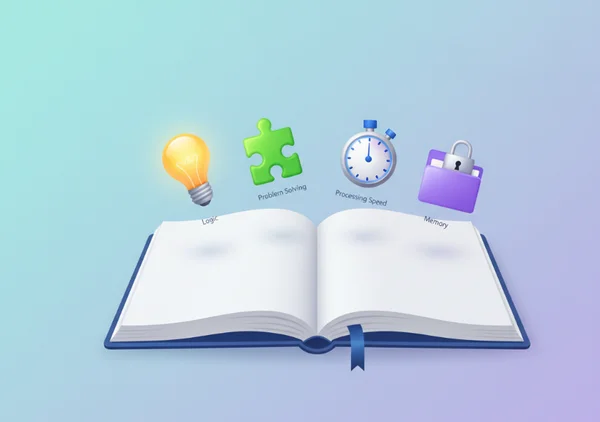
To move beyond a dictionary definition, it helps to look at real-world applications. The human brain doesn't just do "one thing"—it performs dozens of specialized tasks simultaneously.
Exploring the Main Categories
While there are many specific skills, they generally fall into a few primary categories:
- Memory: This isn't just one monolithic skill; it includes short-term memory (holding a phone number in your mind just long enough to dial it), long-term memory (remembering your childhood dog's name), and visual-spatial memory.
- Attention: Your ability to focus on a specific task while ignoring surrounding distractions (sustained attention) or to multitask effectively (divided attention).
- Logic and Reasoning: The capacity to solve complex problems, recognize abstract patterns, and make sound decisions based on given information.
- Auditory and Visual Processing: How accurately and quickly your brain interprets what your eyes see and your ears hear.
- Executive Functions: Higher-level cognitive skills like planning, organizing, regulating emotions, and executing complex, multi-step tasks.
Why Should You Assess Your Brain Health?
Understanding the definition of cognitive abilities naturally leads to a crucial question: How healthy are mine?
Monitoring your cognitive health is just as important as tracking your blood pressure or cholesterol levels. For proactive individuals, establishing a cognitive baseline early allows you to notice subtle, age-related changes over time. If you are a concerned family member noticing that an aging parent is withdrawing from conversations or struggling with names, assessing their cognitive baseline can provide objective data to share with a medical professional, helping to distinguish between normal aging and potential decline.
The Cognitive Ability Test Definition: How We Measure the Mind
You cannot improve or protect what you do not measure. A cognitive ability test definition in a clinical or scientific context refers to a standardized, structured assessment designed to measure specific mental capabilities objectively. Instead of relying on a subjective feeling ("I feel forgetful today"), these rigorous tests provide quantifiable, actionable data.
Why Test 22 Core Cognitive Skills?
Many online brain games claim to test your cognition but only measure two or three basic functions, like simple reaction time or working memory. This is like trying to understand your overall physical health by only measuring your height.
To get a true, holistic picture of your brain health, you must evaluate the whole system. A comprehensive cognitive assessment evaluates all critical areas—from working memory and shifting attention to spatial perception and auditory processing.
Understanding the definition is only the beginning. Find out exactly where your brain stands by testing your 22 core skills today.
Take the Scientific Cognitive Test
How to Get a Comprehensive, AI-Enhanced Cognitive Profile
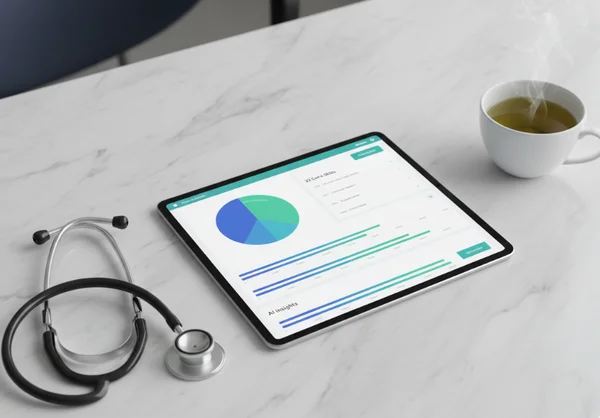
Relying on outdated, overly generalized tests is no longer necessary. At CognitiveTest.me, our premier platform is built on established neuropsychological science, trusted by researchers, and designed for unmatched user accessibility.
When you complete our assessment, you don't just get a raw numerical score. You receive an immediate summary of your performance across 22 distinct cognitive domains. Furthermore, for those who choose to provide anonymous demographic information, our platform utilizes advanced AI to generate a deeply personalized profile. This AI-enhanced insight details your specific cognitive strengths, highlights areas for potential improvement, and provides actionable, daily recommendations tailored to your unique mind.
Don't just guess about your cognitive health. Get an AI-enhanced report trusted by professionals to guide your mental wellness journey.
Frequently Asked Questions
Can cognitive abilities be improved over time?
Yes. Thanks to a concept known as neuroplasticity, the brain has the remarkable ability to reorganize itself by forming new neural connections throughout life. While innate abilities may have genetic caps, cognitive skills can absolutely be maintained and strengthened through targeted cognitive training, continuous learning, physical exercise, and a healthy lifestyle.
Are online cognitive ability tests equivalent to a clinical medical diagnosis?
No. Comprehensive online platforms like CognitiveTest.me are powerful, scientifically grounded tools for screening, tracking baselines, and identifying specific cognitive strengths and weaknesses. However, they are not a substitute for a formal clinical medical diagnosis. If significant cognitive decline is detected, these objective reports should be shared with a neurologist or clinical psychologist for formal medical evaluation.
How do professionals use cognitive assessment tools?
Clinical psychologists, healthcare researchers, and educators rely on standardized cognitive assessments to gather reliable, bias-free data. They use this robust data to monitor the progression of conditions like mild cognitive impairment (MCI), evaluate the effectiveness of clinical interventions, and support extensive academic or therapeutic research. The same rigorous framework used by these professionals is what powers comprehensive online testing platforms.