What is Cognitive Function? A Guide to Your Brain’s Performance
Have you ever walked into a room and forgotten why you went there? Moments like this often lead people to ask: what is cognitive function, and what does it say about daily mental performance? Cognitive function isn’t just “being smart.” It’s the set of brain processes that help you focus, remember, plan, and make decisions. In this guide, we’ll break down the core domains, explain what changes are normal, and share practical ways to support brain health. If you want a simple starting point, you can also explore our cognitive test for a clearer view of your strengths.
The Science of Thinking: What is Cognitive Function in Psychology?
When we look at the human mind through the lens of science, we see a complex network of abilities. In the world of psychology, what is cognitive function refers to the mental processes that allow us to carry out any task. It involves how we perceive information, how we store it, and how we use it to solve problems. Think of your brain not as a single computer, but as a sophisticated mental toolkit. Each tool in the kit has a specific job, whether it is calculating a tip or recognizing a friend’s face in a crowd.
Psychologists distinguish these functions from general intelligence (IQ). While IQ is often seen as a measure of potential, cognitive function is about the active execution of that potential. It is dynamic and can fluctuate based on stress, age, and even sleep. Understanding this distinction helps us realize that having a bad brain day doesn't mean you are less intelligent. It simply means certain cognitive processes are temporarily less efficient.
The Mental Toolkit Analogy: How Your Brain Processes the World
To simplify this, imagine your brain as a workspace. Some people have a massive desk (working memory) where they can juggle many files at once. Others have an incredible filing cabinet (long-term memory) where they can retrieve information from decades ago. By viewing your mind this way, you can start to appreciate the unique strengths of your own cognitive profile. This perspective encourages self-compassion rather than frustration when you face mental hurdles.
Decoding the 5 Core Domains: Cognitive Functioning Examples
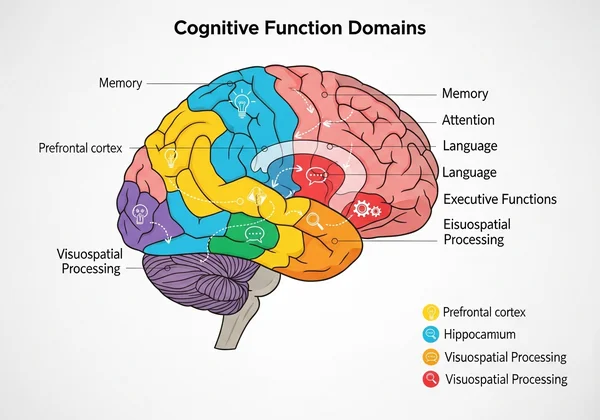
To truly answer what is cognitive function, we must break it down into its primary components. Most neuropsychologists describe five core domains. Understanding these helps you identify where you shine and where you might need more support.
1. Attention: The Brain's Gatekeeper
Attention is the ability to focus on specific information while filtering out distractions. Without it, you couldn't read this sentence while a television is playing in the background. Cognitive functioning examples of attention include sustained attention (focusing on a task for a long time) and divided attention (multitasking).
2. Memory: Distinguishing Working Memory from Long-Term Storage
Memory isn't a single bucket. It is a multi-layered system.
- Working Memory: This is your brain's sticky note. It holds information briefly while you use it, like remembering a phone number just long enough to dial it.
- Long-Term Memory: This is your hard drive, where you store facts, skills, and life experiences for years.
3. Executive Function: The CEO of Your Mind
This is perhaps the most critical domain for adult life. Executive function allows you to plan, organize, and execute complex goals. If you can break down a large project into small steps and stay on schedule, your executive functions are working well.
4. Language: Finding and Understanding Words
Language includes understanding what you hear or read, and expressing your thoughts clearly. It also covers word-finding, naming objects, and following complex instructions. When language is under strain, you may know what you want to say but struggle to find the right word.
5. Visuospatial Skills: Navigating Space and Patterns
Visuospatial skills help you judge distance, recognize shapes, and understand where objects are in space. This is what allows you to park a car, read a map, or quickly spot patterns in a visual layout. It also supports everyday tasks like assembling furniture or navigating a new place.

Normal Aging vs. Cognitive Decline: Recognizing the Signs
As we get older, it is natural for our processing speed to slow down slightly. You might take a few seconds longer to remember a name, or you might find it harder to learn a new software. However, it is vital to understand patterns that may point toward more significant impairment. Distinguishing between normal aging and decline can help reduce unnecessary anxiety.
When we talk about what is impaired cognitive function, we are looking at changes that interfere with daily life. Forgetting where you put your keys is normal; forgetting what keys are used for is a red flag. To help you navigate this, use the following checklist to observe your own patterns.
The Red Flag Observation Checklist
- Persistent Confusion: Frequently losing track of the date or season.
- Difficulty with Familiar Tasks: Struggling to follow a recipe you have made for years.
- Word-Finding Issues: Frequently substituting words with that thing because you can't find the right term.
- Judgment Changes: Making uncharacteristically poor financial decisions or neglecting personal hygiene.
- Spatial Disorientation: Getting lost in a neighborhood you’ve lived in for a long time.
The Role of Stress and Anxiety in Mental Fog
It is important to remember that mental health plays a massive role in performance. If you are under extreme stress or suffering from chronic anxiety, you might experience pseudo-impairment. This feels like cognitive decline, but it is actually your brain’s resources being diverted to manage emotional survival. Prioritizing rest often restores these functions.
Beyond a Single Score: Why Your Cognitive Profile Matters
Most people think of brain health as a pass/fail grade. In reality, everyone has a unique cognitive fingerprint. You might be incredibly strong in visuospatial tasks but struggle with verbal memory. Or, you might be an executive functioning powerhouse but have a shorter attention span.
Understanding your specific profile is empowering. It allows you to build a life that plays to your strengths. For instance, if you know your working memory is a weaker point, you can lean on external tools like digital calendars and checklists. This doesn't make you lesser; it makes you a more efficient manager of your own mind.
Mapping Your Strengths: How to Explore Your Cognitive Profile
Once you understand the basics of what is cognitive function, the next logical step is self-discovery. Learning about your brain should be an exciting journey, not a scary one. By establishing a baseline, you can track your performance over time and make informed decisions about your lifestyle and health.
At CognitiveTest.me, we believe that everyone deserves access to high-quality insights about their mind. Our platform offers a way to explore your traits in a supportive, non-clinical environment.
Please note: This tool is designed for educational purposes and personal self-reflection. It is a powerful way to understand your cognitive domains, but it is not a substitute for a clinical diagnosis by a medical professional.

Proactive Brain Health: How to Improve Cognitive Function
The most exciting discovery in modern neuroscience is neuroplasticity. This is the brain’s ability to reorganize itself by forming new neural connections throughout life. This means you aren't stuck with the brain you have today. You can actively influence how to improve cognitive function through consistent, healthy habits.
Your Daily Brain Health Action Plan
- Prioritize Deep Sleep: Sleep is when your brain flushes out metabolic waste and consolidates memories. Aim for 7–9 hours of quality rest.
- Move Your Body: Physical exercise increases blood flow to the brain and stimulates the release of BDNF, a protein that supports neuron growth.
- Feed Your Mind: Diets high in antioxidants, healthy fats (like Omega-3s), and leafy greens have been shown to protect cognitive longevity.
- Challenge Your Comfort Zone: Learning a new skill—like playing an instrument or a new language—forces your brain to create new pathways.
- Stay Socially Connected: Meaningful conversation is one of the most complex cognitive tasks we perform. Isolation is a known risk factor for decline.
Empowering Your Mental Journey
Understanding what is cognitive function is the first step toward a more mindful and proactive life. Your brain is a dynamic, living system that responds to how you treat it. By recognizing the different domains of your mind and distinguishing between normal changes and red flags, you can navigate change with more confidence and less fear.
Remember that mental performance is a journey, not a destination. If you’d like a simple baseline to start from, you can try our cognitive test online and use the results as a personal reference point over time. Your brain is your most valuable asset—treat it with curiosity and care.
Frequently Asked Questions
Is cognitive function the same as IQ?
No, they are different concepts. IQ measures your intellectual potential and reasoning ability. Cognitive function refers to the specific mental processes (like memory, attention, and language) that you use to perform daily tasks.
Can anxiety make me feel like I have cognitive impairment?
Yes, absolutely. High levels of stress and anxiety can cause mental fog, making it difficult to focus or remember things. This is often temporary and improves once the stress levels are managed.
What causes temporary changes in cognitive performance?
Many factors can cause your brain to feel off, including lack of sleep, dehydration, nutritional deficiencies, and even certain medications. Monitoring your lifestyle is usually the first step in identifying these causes.
Why should I track my cognitive health over time?
Tracking your cognitive profile helps you establish a baseline. This allows you to notice subtle changes early on and provides valuable data if you ever need to consult a healthcare professional.
At what age does cognitive function start to change?
Subtle changes in processing speed can begin as early as your 30s or 40s, but this is usually not noticeable in daily life. Most people begin to notice more significant, yet still normal, changes in their 60s and 70s.