What Is General Ability? A Practical Guide to G, Cognitive Skills, and Test Results
General ability is a broad way to describe how well a person can learn, reason, solve new problems, and adapt thinking across different tasks. You may see it called general mental ability, general cognitive ability, or simply g in psychology. Searchers often arrive at this topic because they want a plain definition, examples of cognitive abilities, or help understanding a general ability test. This guide explains the idea without turning it into a label. If you want to explore your own thinking patterns in a structured, educational way, an online cognitive assessment can be a useful starting point, especially when you treat the results as insight rather than a final judgment.
What General Ability Means
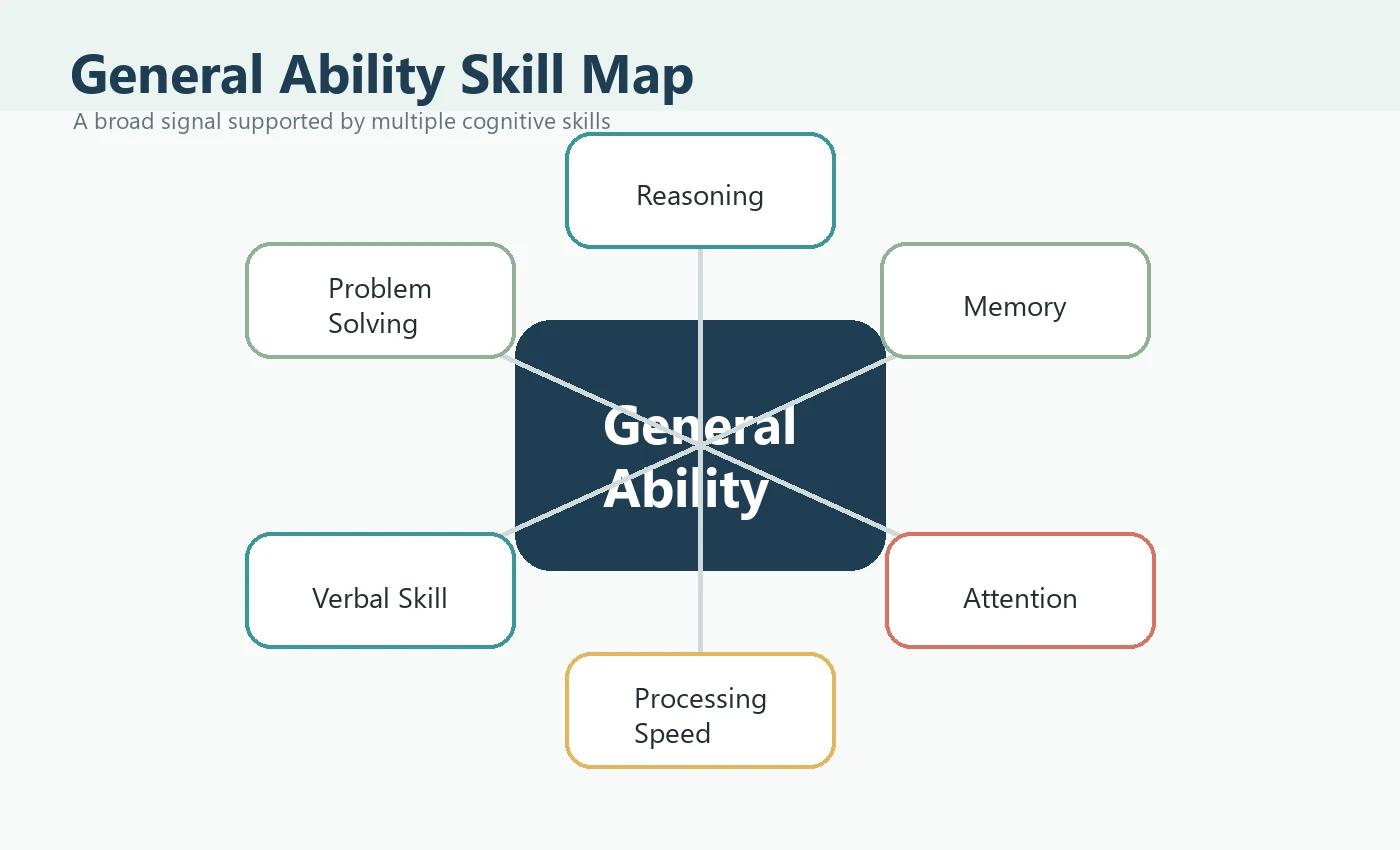
General ability is the shared mental capacity that helps people perform across many kinds of cognitive tasks. A person who learns a new rule quickly in one setting may also handle pattern recognition, verbal reasoning, planning, or unfamiliar problem solving more efficiently in another. That overlap is what researchers often mean by g.
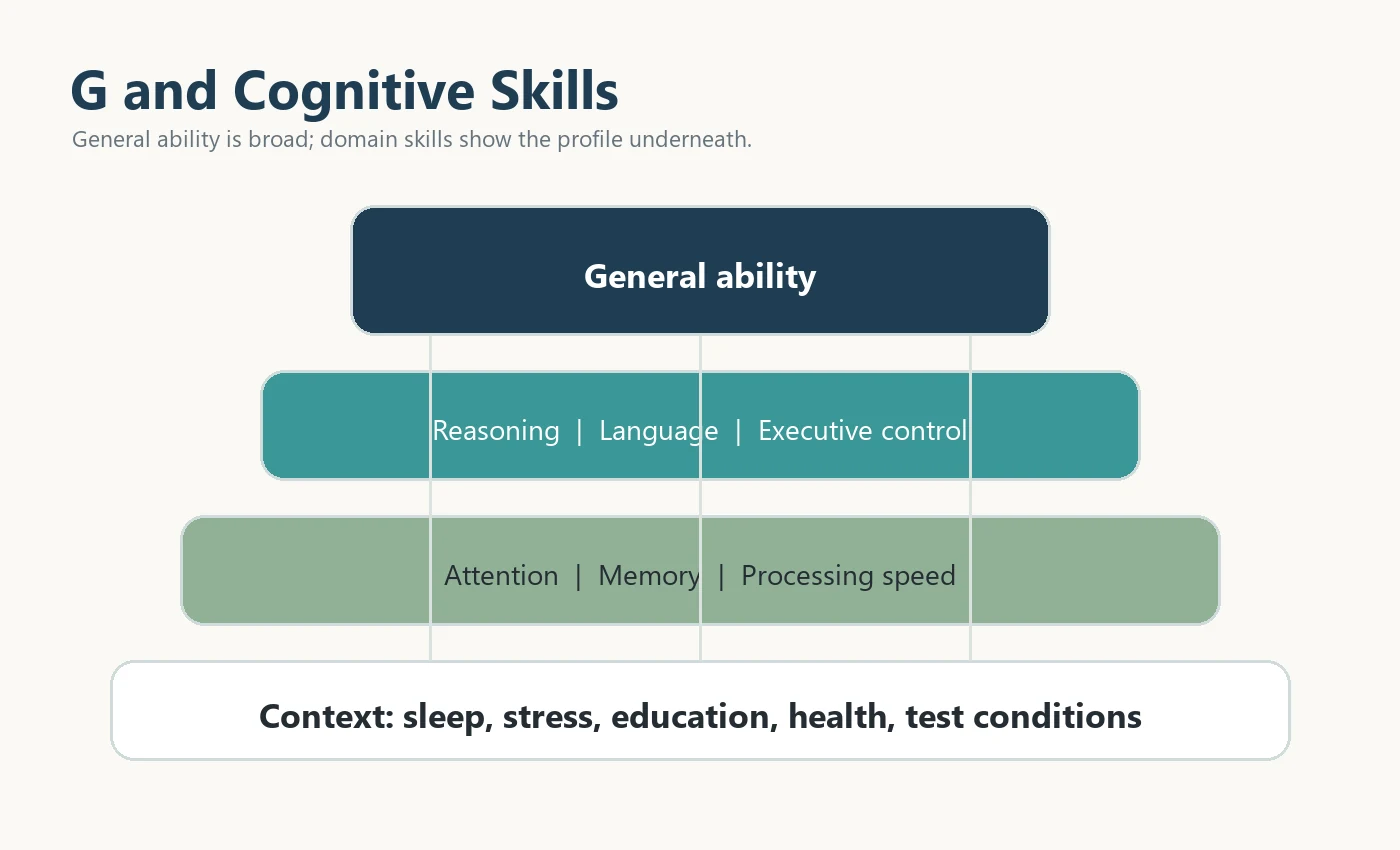
This does not mean every skill is the same. Cognitive performance is layered. One person may be especially strong in verbal reasoning and average in mental rotation. Another may work quickly under time pressure but need more support with complex instructions. General ability is the broad background signal, while specific abilities describe the profile underneath it.
A helpful analogy is physical fitness. Overall fitness matters, but it does not erase differences between endurance, flexibility, coordination, and strength. In the same way, general cognitive ability can influence many tasks, while individual domains still tell you where your thinking is most efficient.
General Ability, IQ, and Cognitive Skills Are Related but Not Identical
People often ask whether g is the same as IQ. They overlap, but the terms are not interchangeable. IQ is usually a score from a standardized intelligence test. General ability is the broader construct those tests often try to estimate. Cognitive skills are the component abilities that contribute to performance, such as attention, working memory, processing speed, verbal comprehension, fluid reasoning, and executive function.
The General Ability Index, or GAI, is another term searchers encounter. In some formal test batteries, GAI can refer to a score that emphasizes reasoning and verbal or perceptual abilities while giving less weight to working memory and processing speed. That can be useful in certain professional assessment contexts, but it should be interpreted by qualified professionals who understand the test, the person, and the reason for assessment.
For everyday learning, the key point is simpler: general ability helps explain why performance across different mental tasks is often connected, but a single score never captures the whole person. Motivation, sleep, stress, education, culture, language background, test familiarity, health, and environment can all affect how someone performs on a given day.
What a General Ability Test Usually Measures
A general ability test is designed to sample several kinds of reasoning instead of measuring only memorized knowledge. Depending on the test, it may include pattern completion, verbal analogies, number series, logic puzzles, spatial reasoning, short memory tasks, or quick decision tasks. Some employment tests also use timed sections to estimate how efficiently a person handles unfamiliar information.
Common modules include:
- Abstract reasoning, such as identifying rules in shapes or patterns.
- Verbal reasoning, such as understanding relationships between words or ideas.
- Quantitative reasoning, such as finding number patterns or applying simple logic.
- Working memory, such as holding information in mind while using it.
- Processing speed, such as completing accurate responses within time limits.
- Attention control, such as staying focused while filtering distractions.
Different tests weigh these areas differently. A school placement test, workplace selection test, neuropsychological battery, and online cognitive screening tool may all use the phrase general ability, but their goals are not the same. One may support hiring decisions, another may support educational planning, and another may help someone understand their cognitive profile for personal reflection.
That is why context matters. A result is most meaningful when you know what the test was built to measure, who it was designed for, what comparison group it uses, and what limitations apply.
How to Read Results Without Over-Interpreting Them
General ability results can be useful, but they are not a personality summary or a permanent ceiling. A score is a snapshot of performance under specific conditions. It may show relative strengths, possible challenge areas, or a pattern worth watching over time. It should not be used alone to explain a person, predict their future, or make health conclusions.
Start with the purpose of the assessment. Was it measuring broad reasoning, job-related aptitude, academic readiness, or a multi-domain cognitive profile? Then look at the structure. A single overall score can be convenient, but subdomain patterns often tell the more practical story. For example, strong reasoning with slower processing speed may suggest that accuracy is better than pace. Strong verbal ability with weaker working memory may suggest that written notes, chunking, or step-by-step routines could help in demanding tasks.
Use ranges carefully. Terms like average, high average, or below average usually compare performance with a reference group. They do not describe worth, effort, creativity, judgment, or potential. They also do not explain why a result occurred. Fatigue, unfamiliar item formats, test anxiety, language demands, distractions, or technical issues can influence performance.
When results feel surprising or emotionally loaded, pause before drawing big conclusions. It can help to retest only when appropriate, compare patterns across domains, or discuss concerns with a qualified professional, especially if cognitive changes are affecting school, work, safety, or daily life.
Practical Ways to Prepare for a General Ability Test
Preparation should focus on understanding the format and reducing avoidable friction, not hunting for answer sheets. Searches for answer PDFs are common, but memorized answers do not build useful skill and may mislead you about your actual performance. Better preparation makes the testing experience cleaner.
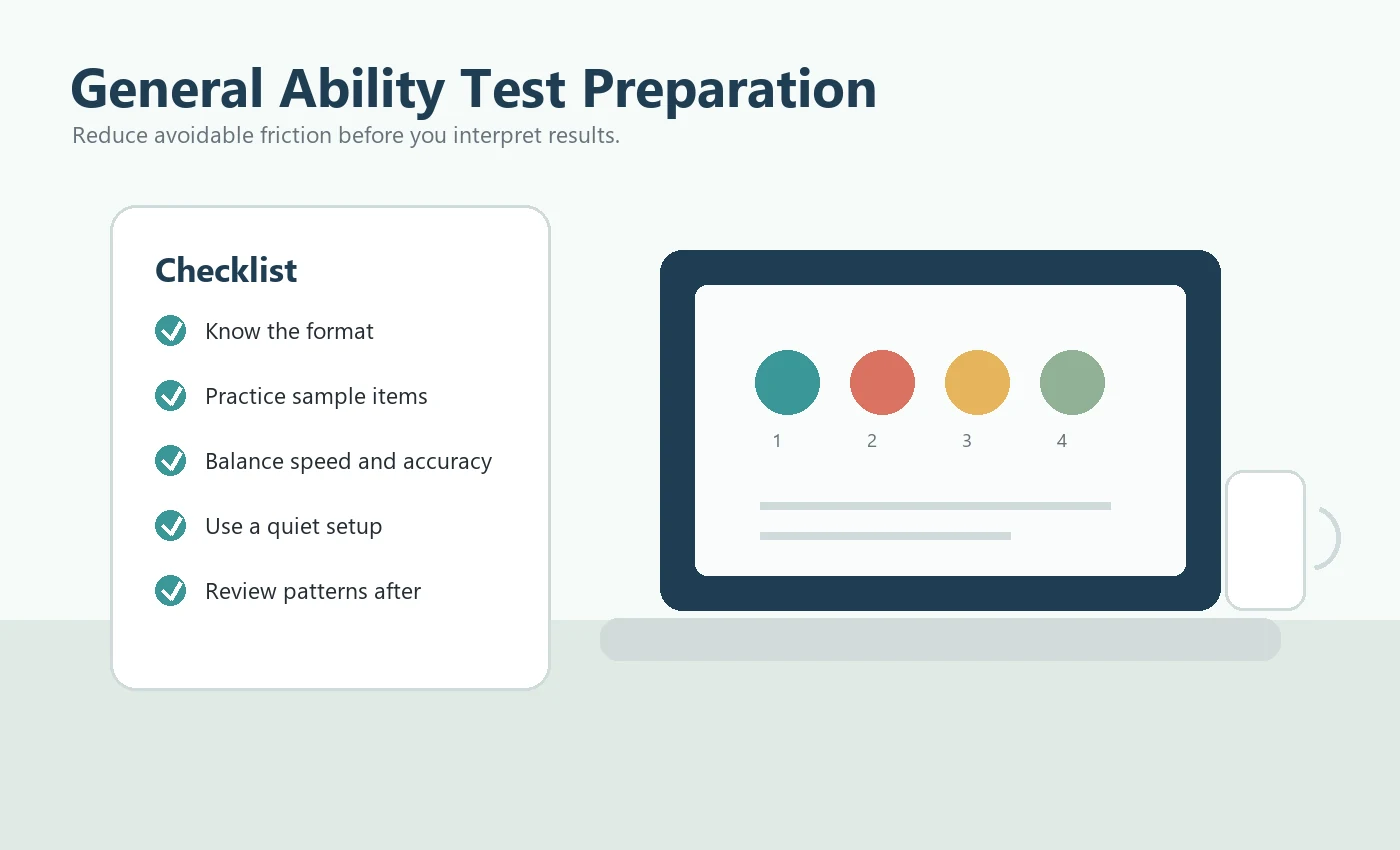
Use this checklist before a general ability assessment:
- Review the test instructions and sample item types if they are provided.
- Practice a few untimed examples first so the format feels familiar.
- Notice whether the test rewards speed, accuracy, or a balance of both.
- Sleep adequately and avoid taking the test during a rushed or distracted period.
- Use a quiet space, stable internet connection, and comfortable screen setup.
- Read each instruction carefully before the timer begins, if the platform allows it.
- Afterward, review patterns rather than focusing only on the final score.
If you are using a cognitive tool for self-reflection, a wider profile can be more useful than one number. CognitiveTest.me is built around multiple cognitive domains, so cognitive profile exploration can support questions about strengths, challenges, and baseline tracking without reducing your thinking to a single label.
When General Ability Matters in Real Life
General ability is relevant because many everyday demands require flexible thinking. Learning a new software tool, comparing choices, following complex instructions, planning a project, adapting to a new job, or solving an unfamiliar problem all draw on broad cognitive resources. In school and work, general ability can influence how quickly someone grasps new material. In personal life, it can shape how easily someone organizes information, reasons through options, or manages competing tasks.
Still, real-life performance is never only general ability. Expertise, persistence, values, communication skills, emotional regulation, physical health, social support, and opportunity all matter. A person can compensate for weaker areas with good systems, and a strong score does not automatically produce good habits or good decisions.
This balanced view is especially important for parents, caregivers, and adults who are worried about change. A general ability measure may point to questions worth exploring, but it should be combined with observations, history, context, and professional guidance when concerns are significant. Educational tools can make patterns easier to see; they do not replace a full clinical or educational evaluation.
Using General Ability as a Starting Point
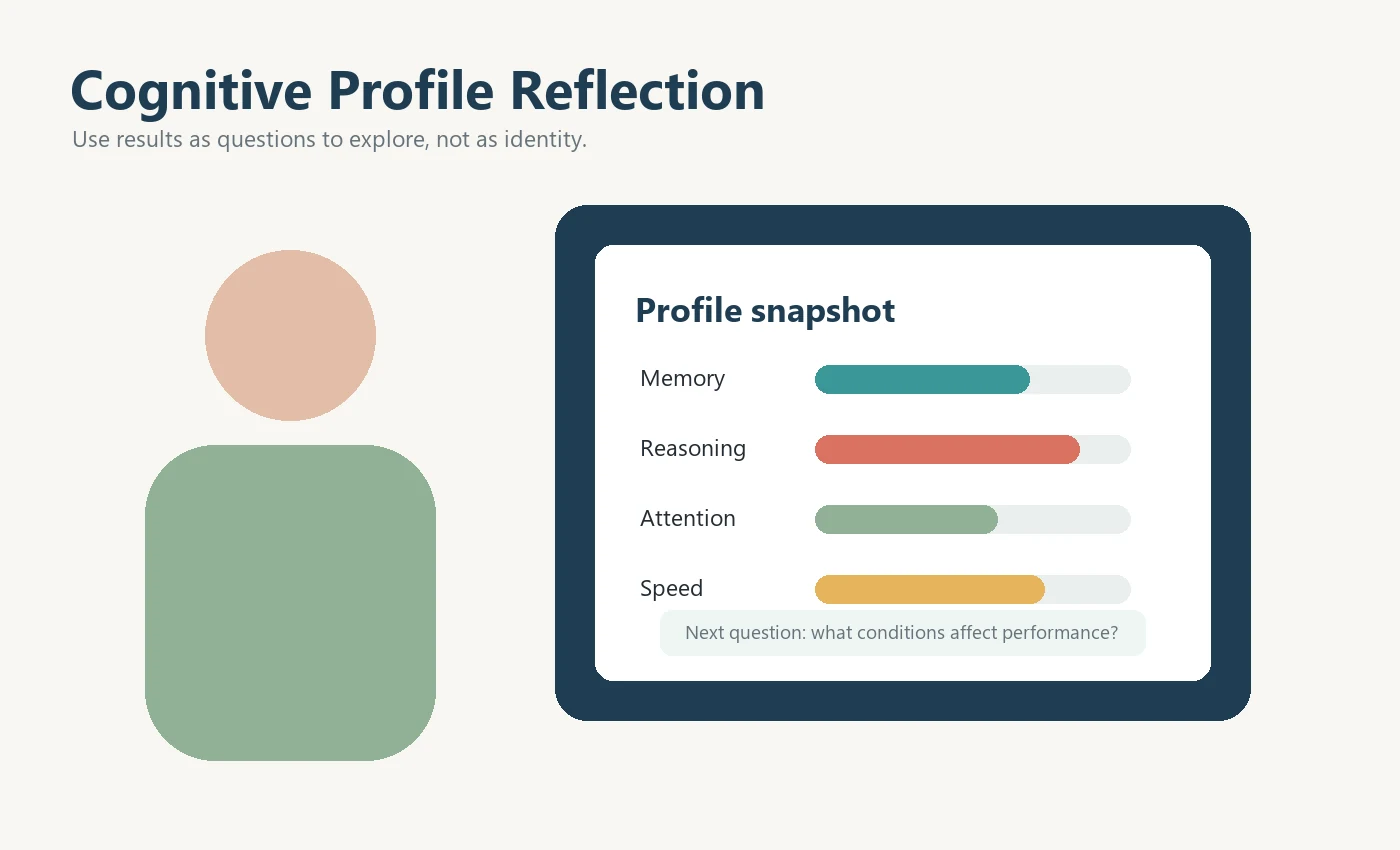
The best use of general ability is not to place yourself in a fixed category. It is to ask better questions: Which tasks feel easiest? Which tasks drain attention fastest? Do results change when sleep, stress, or practice conditions change? Are there patterns across memory, attention, reasoning, language, and processing speed?
That is where a multi-domain approach can be more helpful than a single general ability score. If you want an educational overview of cognitive strengths and possible challenge areas, an educational cognitive test experience can help you organize observations and decide what to explore next. Keep the framing gentle: results are information, not identity. They can support better questions, more useful routines, and more informed conversations.
FAQ
What is general ability in simple terms?
General ability is the broad mental capacity that supports learning, reasoning, problem solving, and adapting to new information. It helps explain why performance in different cognitive tasks is often related, even though each skill still has its own pattern.
What is the difference between g and IQ?
G is the psychological construct of general cognitive ability. IQ is usually a standardized score from a test designed to estimate aspects of intelligence. Many IQ tests are influenced by g, but IQ scores also depend on the specific test design, norms, subtests, and testing conditions.
What are examples of cognitive abilities?
Examples include verbal reasoning, visual-spatial reasoning, working memory, processing speed, attention, executive function, learning, and problem solving. A general ability test may sample several of these areas to estimate broad cognitive performance.
Is general ability fixed for life?
General ability is relatively stable compared with short-term moods, but test performance can still be affected by development, aging, health, sleep, stress, education, practice, language demands, and testing conditions. Specific strategies and supports can also improve how effectively people use their abilities.
What is a general ability measure for adults?
An adult general ability measure is an assessment designed to estimate broad reasoning or cognitive performance in an adult comparison group. Depending on the setting, it may be used for education, employment, research, or personal cognitive insight.
Are general ability tests the same as job aptitude tests?
Not always. Some job aptitude tests include general cognitive ability tasks because reasoning and learning speed can matter at work. Other general ability assessments are broader, educational, or clinical in purpose. The meaning depends on the test and the context.
Should I use one score to judge my cognitive health?
No. One score is only a snapshot. A fuller view considers domain patterns, daily functioning, history, context, and changes over time. If cognitive concerns affect daily life, school, work, safety, or independence, speak with a qualified professional.