What to Expect on a Sample Cognitive Test: A Complete Guide
Whether you are a proactive adult wanting to establish a healthy baseline for your memory, a concerned family member trying to evaluate an aging parent's mental sharpness, or a researcher looking for reliable assessment tools, searching for a "sample cognitive test" is a smart first step. Understanding how your brain uniquely processes information, stores memories, and solves complex problems is vital for long-term health and well-being.
Cognitive tests are not terrifying diagnostic interrogations; they are highly structured, scientifically informed puzzles designed to highlight your specific neurological strengths and pinpoint areas that might require a little extra support. In this comprehensive guide, we will break down exactly what a cognitive test looks like, what types of questions you can expect to answer, and how to safely, accurately test your cognitive skills today with tools like CognitiveTest.me.

What is a Cognitive Assessment?
At its core, a cognitive test is a standardized evaluation used to measure various incredibly specific functions of the human brain. While they cannot definitively diagnose complex neurological conditions like Alzheimer's disease or severe dementia on their own, they are universally considered the indispensable first line of defense. They act as an advanced screening tool to identify mild cognitive impairment (MCI) before it significantly impacts daily life.
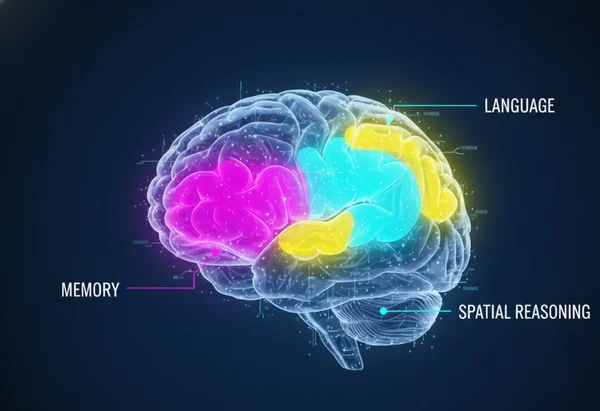
These assessments are rigorously designed to evaluate multiple different "domains" of your brain's functionality, ensuring a completely holistic view of your mental agility.
Core Areas Evaluated in a Sample Cognitive Test
When you sit down to take a structured cognitive evaluation, you aren’t just answering random trivia questions. Good tests are meticulously divided into specific psychological categories. Here is a breakdown of the core domains and the types of sample cognitive test questions you might encounter:
1. Memory and Recall
Short-term and working memory are often the first cognitive skills people worry about losing as they age.
- Sample Task: The assessor (or digital platform) will display a list of 3 to 5 completely unrelated words (e.g., Apple, Table, Penny). You will be asked to immediately repeat them, and then, after completing several other distracting tasks, you will be asked to successfully recall those exact same words again 5 minutes later.
2. Visuospatial Skills
This measures your brain's ability to accurately process visual information and beautifully understand the spatial relationships between different physical objects.
- Sample Task: You might be asked to perfectly copy a complex 3D shape, like a wireframe cube, or precisely draw the face of a clock, ensuring all numbers are in the correct positions and the hands are accurately pointing to a highly specific time (e.g., "ten past eleven").
3. Executive Function and Reasoning
Executive function acts as your brain’s CEO. It governs your ability to plan ahead, solve novel problems, deeply focus, and strictly control sudden impulses.
- Sample Task: You might be asked to rapidly subtract 7 from 100, and then continually subtract 7 from the resulting number (93, 86, 79...) as quickly and accurately as possible. Another common task involves identifying the abstract relationship between two specific items, such as determining how a "watch" and a "ruler" are conceptually similar (they both measure things).
4. Language and Literacy
These specific tests evaluate your brain's ability to comfortably understand language, generate correct words, and name familiar objects without hesitation.
- Sample Task: You may be shown distinct pictures of relatively uncommon animals (like a rhinoceros or a camel) and asked to instantly name them. Alternatively, you might be given exactly one minute to list as many words as you can possibly think of that begin with the letter "F".
Why Should You Take a Cognitive Test?
The motivations for seeking out a sample cognitive test vary wildly, but they generally fall into three vital categories:
- The Proactive Health Monitor: Many vibrant adults in their 50s and 60s want to responsibly establish a "baseline." By taking a scientifically validated test today, they have accurate, personalized data to strictly compare against if they ever experience sudden "brain fog" or strange memory lapses five years down the line.
- The Concerned Family Member: If you notice that an incredibly sharp aging parent is suddenly forgetting how to navigate familiar roads or struggling to manage their checking account, encouraging them to take a low-stress, accessible online cognitive screening in the comfort of their own home can provide you both with objective, actionable data before scheduling a stressful doctor's appointment.
- The Professional Researcher: Clinical psychologists, dedicated neurologists, and academic researchers rely heavily on standardized cognitive tests to accurately track patient progress over time or evaluate the true efficacy of new medical interventions.
Exploring the Comprehensive CognitiveTest.me Platform
While you can certainly find basic, 5-question printable quizzes online, evaluating your brain health requires a much higher standard of scientific rigor. This is where CognitiveTest.me bridges the massive gap between simple entertainment quizzes and expensive, inaccessible clinical evaluations.
Developed by a dedicated team of neuroscientists and data experts, this powerful platform offers incredibly comprehensive evaluations based on heavily established protocols. Instead of just testing one or two basic skills, it comprehensively evaluates up to 22 distinct cognitive domains in a user-friendly, 30-minute digital format.
Most importantly, CognitiveTest.me doesn't just leave you staring at confusing numerical scores. By utilizing optional, cutting-edge AI technology, the platform generates a deeply personalized, easy-to-understand summary report specifically highlighting your unique cognitive strengths while responsibly offering actionable steps to heavily improve areas of challenge. It is the perfect, scientifically sound starting point for anyone serious about understanding their profound mental capabilities.
Conclusion
Understanding "what" happens during a cognitive assessment demystifies the entire process, entirely transforming a potentially scary medical concept into an incredibly empowering tool for long-term self-care. Whether evaluating your own sharp mind or carefully supporting a loved one, knowing the specific difference between spatial reasoning and working memory allows you to have far more productive conversations about brain health. Do not wait for severe cognitive decline to become undeniably obvious; take proactive control of your neurological health today by exploring a deeply comprehensive, scientifically validated sample cognitive test.
Frequently Asked Questions
What happens if I perform poorly on a sample cognitive test?
Please do not panic. An initially poor result on an online screening is absolutely not a medical diagnosis of dementia or Alzheimer's. Temporary factors like severe sleep deprivation, high stress, depression, anxiety, or even simple medication side effects can drastically lower your cognitive scores. A low score simply serves as a valuable signal that you should schedule an appointment with a licensed healthcare provider for a more comprehensive clinical evaluation.
Are online cognitive tests as reliable as doctor-administered tests?
High-quality, scientifically designed platforms that meticulously measure multiple distinct domains (such as CognitiveTest.me) provide incredibly reliable baseline data and are excellent screening tools. However, they are designed to supplement, never replace, formal clinical diagnosis by a neuropsychologist or neurologist who can physically observe your behavior during testing.
How often should I take a cognitive assessment?
If you are completely healthy and simply establishing a proactive baseline, taking a comprehensive test once every 1 to 2 years is generally considered sufficient. If you or a concerned family member are actively monitoring a diagnosed mild cognitive impairment, your doctor may recommend taking assessments every 6 months to accurately track your progression.
Can I actually improve my cognitive test scores?
Yes! The human brain possesses incredible "neuroplasticity"—the profound ability to form new neural connections throughout your entire life. Engaging in regular, intense physical exercise, maintaining a heart-healthy diet, intensely learning new, difficult skills (like a second language or a musical instrument), and staying highly socially engaged are all scientifically proven methods to actively protect and potentially improve your cognitive function scores over time.
Is a cognitive test an IQ test?
No. An IQ (Intelligence Quotient) test is explicitly designed to measure your raw, innate intellectual potential and complex problem-solving abilities compared to others in your specific age group. A cognitive test is designed strictly to measure the actual, practical functioning of specific brain mechanisms (like short-term memory recall and processing speed) to screen strictly for medical impairment or decline, not raw intelligence.
CommentCtrl+Alt+M