Behavioral and Cognitive Assessment: Examples, Tools, and Adult Questions
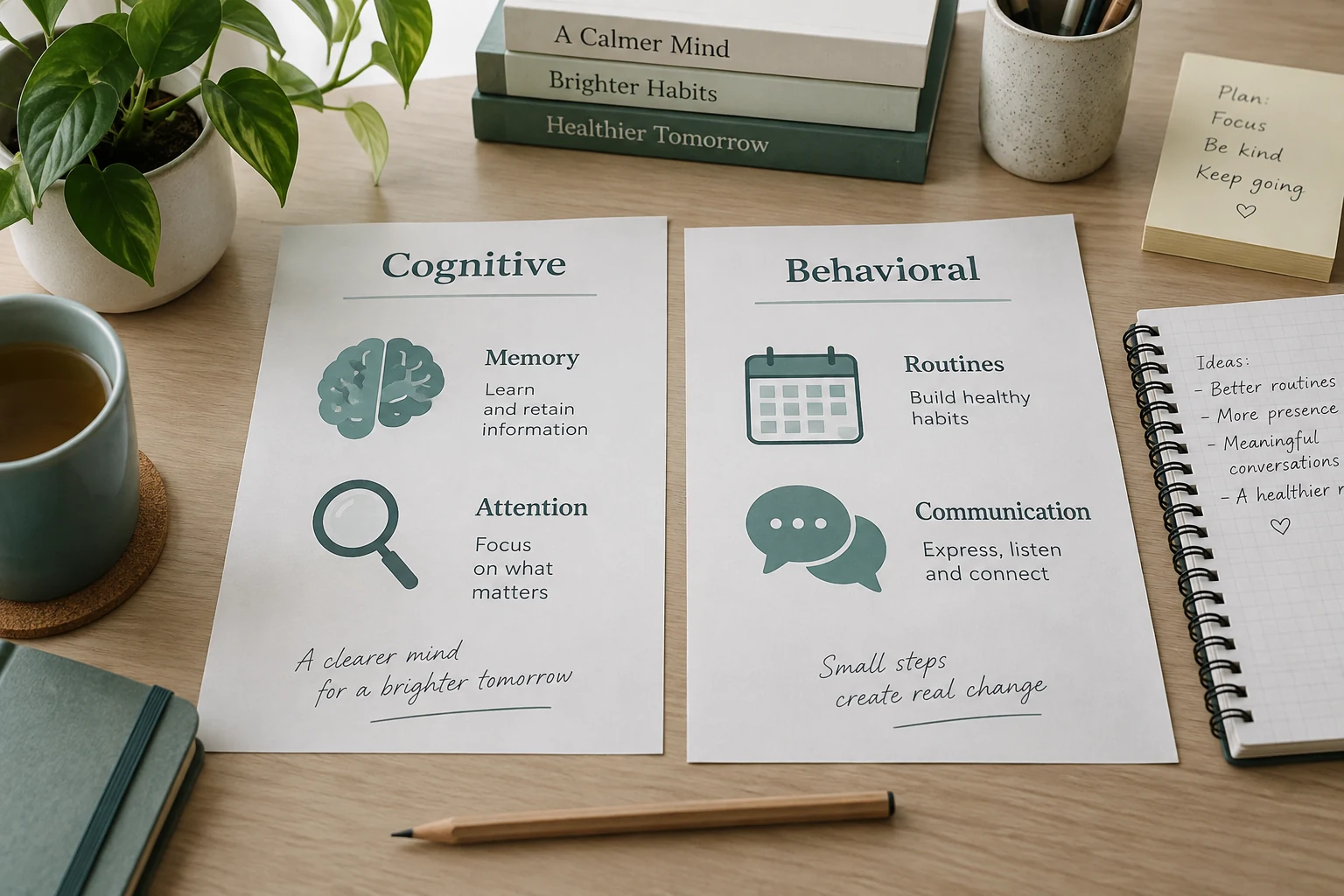
A behavioral and cognitive assessment can sound like one large exam, but it is really two related ways of understanding how a person functions. Cognitive assessment looks at mental skills such as attention, memory, reasoning, processing speed, language, and problem solving. Behavioral assessment looks at observable patterns: how a person responds to tasks, manages emotions, communicates, follows routines, or adapts to different settings.
For adults, the two lenses often work best together. A cognitive score may show that a task was difficult; behavioral information can help explain what the person did when the task became difficult. That combination is useful in healthcare, education, research, and workplace settings when results are interpreted carefully. If you want an educational starting point for cognitive strengths and challenges, CognitiveTest.me offers a structured cognitive profile designed for insight rather than pressure.
What Behavioral and Cognitive Assessment Measures
A cognitive assessment asks, "What mental skills are being used, and how efficiently?" Depending on the setting, it may measure memory, attention, reasoning, executive function, processing speed, orientation, learning, or decision making. Some tools are brief screens; others are longer batteries administered by trained professionals.
A behavioral assessment asks, "What patterns can be observed across situations?" It may include observation, rating scales, interviews, self-monitoring logs, caregiver reports, workplace feedback, or structured questionnaires. Instead of only asking whether a person can solve a problem, it looks at how that person approaches the problem.
The overlap matters. An adult may miss steps in a task because of attention, working memory, stress, unclear instructions, sleep problems, or the environment. A cognitive measure alone may not explain the whole picture, while a behavioral measure alone may miss the cognitive load. Together, they create a more practical map of strengths, challenges, and next steps.
Cognitive vs Behavioral Assessment in Plain English
The simplest distinction is this: cognitive assessment focuses on mental abilities; behavioral assessment focuses on patterns of action and response. Cognitive tasks may involve remembering words, following directions, solving logic items, copying a shape, completing number patterns, naming objects, or answering orientation questions. Behavioral tasks may involve describing habits, rating how often certain actions occur, observing behavior in context, or tracking what happens before and after a repeated behavior.
In a healthcare context, cognitive screening is often used when someone reports memory, attention, language, or thinking changes. A neurologist or other clinician may order a cognitive test to decide whether more detailed evaluation is needed, especially when daily functioning has changed. A brief screen does not tell the full story by itself; it is one piece of information alongside history, physical findings, medication review, mood, sleep, education, and other factors.
In a workplace context, a cognitive tool might estimate learning speed, reasoning, or problem solving for a role. A behavioral tool might explore work style, communication preferences, patience, formality, or collaboration patterns. That can be useful for development conversations when handled fairly and transparently.
For personal self-reflection, the goal is usually simpler: understand your current profile, notice patterns, and decide whether to track changes or discuss concerns with a qualified professional.
Four Common Cognitive Assessment Tools
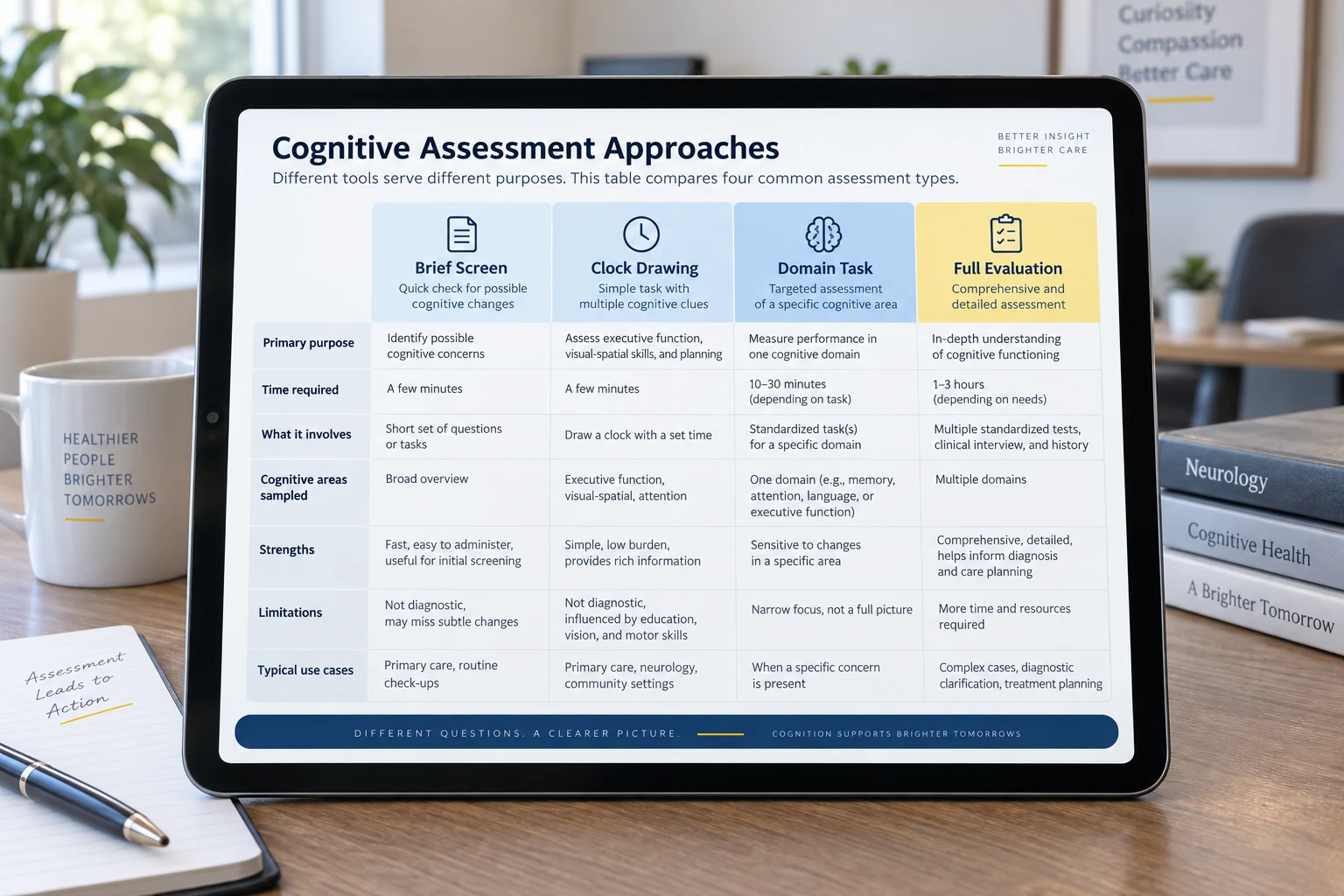
Searchers often ask, "What are 4 common cognitive assessment tools?" The answer depends on the setting, but four widely discussed categories are brief cognitive screens, clock-drawing tasks, domain-specific tasks, and full neuropsychological evaluation.
1. Brief Cognitive Screens
Brief screens are short tools that sample several areas of cognition. They may include orientation, recall, attention, language, drawing, or simple reasoning. Examples in clinical discussions often include tools such as MoCA, MMSE, Mini-Cog, and SLUMS. These tools are designed for screening and triage, not for explaining every possible cause.
2. Clock-Drawing and Visual Tasks
Clock drawing is commonly used because it touches several skills at once: understanding instructions, planning, visuospatial organization, number placement, and motor output. Other visual tasks may involve copying shapes, identifying patterns, or noticing relationships between objects.
3. Domain-Specific Cognitive Tasks
Some tasks focus on one domain more directly. A memory task might ask someone to learn and recall a short word list. An attention task may ask for mental tracking, sequencing, or sustained focus. A language task may involve naming, repeating, reading, or following commands. Executive function tasks may involve switching rules, planning, or inhibiting an automatic response.
4. Full Neuropsychological Evaluation
A full evaluation is more detailed and is typically administered by a trained professional. It may include standardized measures across memory, attention, language, visual reasoning, executive function, mood, effort, and daily functioning. It is usually considered when a brief screen is not enough or when the question is complex.
Behavioral and Cognitive Assessment Examples
Behavioral and cognitive assessment examples are easiest to understand when paired with real-life questions.
Imagine an adult who says, "I keep losing track during meetings." A cognitive lens might look at attention, working memory, processing speed, and verbal comprehension. A behavioral lens might look at sleep schedule, meeting length, note-taking habits, anxiety, multitasking, interruptions, and whether the person performs better with written agendas.
Imagine a family member who says, "My parent repeats the same question." A cognitive lens might look at short-term memory, orientation, language, and executive function. A behavioral lens might look at timing, routine changes, hearing issues, and whether reminders reduce confusion.
Imagine a job candidate completing a timed reasoning assessment. A cognitive lens might look at numerical, verbal, or abstract reasoning under time pressure. A behavioral lens might look at test-taking strategy, response to uncertainty, persistence, and whether accommodations or instructions were clear.
In each example, the assessment is more useful when it avoids jumping to one explanation. Good interpretation asks what the result means in context and what the next reasonable step should be.
What Questions Are Asked on a Cognitive Assessment Test?
People often search for "what are the 30 questions on a cognitive test" or "free cognitive test with answers." It is understandable to want examples, but cognitive tools vary widely. There is no single universal set of 30 questions that applies to every adult or every purpose. Many formal tools also have protected scoring rules, so answer keys are not always appropriate or useful.
Still, common question types include:
- Remembering three to five words after a short delay
- Repeating numbers forward or backward
- Following a multi-step spoken instruction
- Naming objects or describing similarities
- Drawing a clock, copying a figure, or completing a pattern
- Solving simple arithmetic or sequencing items
- Naming the date, place, or current situation
- Explaining how you would respond to a practical scenario
The point is not to "beat" the assessment. For clinical and self-reflection contexts, a representative result is more useful than a rehearsed one. For workplace assessments, preparation usually means understanding the format, resting well, reading instructions carefully, and using time wisely.
How to Read Results Without Overreading Them
One of the most important parts of any behavioral and cognitive assessment is restraint. A low score, confusing behavior pattern, or difficult task does not automatically explain the cause. Fatigue, anxiety, pain, medication effects, sensory issues, unfamiliar technology, language background, sleep, and stress can all affect performance.
Likewise, a strong score does not mean every daily-life concern should be dismissed. Some people compensate well in structured tasks but struggle in noisy or emotionally loaded settings.
Useful interpretation usually asks four questions:
- What was measured?
- What was not measured?
- What conditions may have affected performance?
- What next step would be proportionate?
For many adults, the next step may be simple: create a baseline, track changes over time, adjust habits that affect attention and energy, or bring organized notes to a healthcare appointment. CognitiveTest.me's online cognitive assessment can support that first baseline conversation by presenting results in a structured, easy-to-review format.
Behavioral and Cognitive Assessment for Adults: A Practical Checklist
Before choosing any assessment, clarify the purpose. Are you exploring personal brain health, preparing for a workplace process, supporting a family member, or documenting a change? Purpose shapes the tool.
Use this checklist before you rely on results:
- Check whether the tool is meant for screening, self-reflection, hiring, research, education, or clinical evaluation.
- Look for the cognitive domains covered, such as attention, memory, reasoning, language, perception, and executive function.
- Ask whether behavioral context is included through questionnaires, observation, interviews, or daily-life examples.
- Notice whether results are compared with age-relevant norms or simply reported as raw performance.
- Review privacy practices, especially if personal background information is requested.
- Avoid treating a single result as a permanent label.
- Seek professional guidance when changes are sudden, worsening, unsafe, or affecting daily independence.
A cognitive assessment questionnaire PDF can help organize observations and questions, but it should not replace a thoughtful review of cognitive skills, behavior patterns, health context, and daily function.
When a Low-Pressure Online Cognitive Tool Helps
An online cognitive tool is most useful when you treat it as a structured starting point. It can help you notice patterns, describe strengths and challenges in plain language, and decide whether you want to monitor changes over time. It can also make conversations with a clinician, family member, educator, or coach more concrete because you are not relying only on vague impressions.
At the same time, online results have limits. They cannot account for every medical, emotional, cultural, language, sensory, or environmental factor. The healthiest use is reflective: review the data, look for patterns, and decide what support or follow-up fits the situation.
If you want a calm way to begin, you can explore an educational cognitive testing platform that focuses on cognitive strengths, challenges, and practical insight rather than alarm.

FAQ
How do I pass a cognitive assessment test?
For health or self-reflection contexts, the goal is not to pass in the school-exam sense. The goal is to get a representative picture of how you function that day. Sleep well, use needed glasses or hearing aids, read instructions carefully, and answer honestly. For workplace assessments, become familiar with the format, manage time, and avoid overthinking behavioral items.
Why would a neurologist order a cognitive test?
A neurologist may use cognitive testing when there are concerns about memory, attention, language, thinking speed, problem solving, or daily functioning. The result can help decide whether more detailed evaluation is needed and can provide a baseline for tracking change. It is usually considered alongside medical history and other information.
What does it mean when you fail a cognitive test?
"Fail" is often the wrong word. A below-expected result means the task was harder than expected under the conditions of that assessment. It does not explain the reason by itself. Follow-up may be useful, especially if the result matches real changes in daily life or if concerns are sudden, worsening, or safety-related.
What kind of questions are asked on a cognitive assessment test?
Common tasks may involve word recall, attention, simple arithmetic, orientation, naming, following directions, drawing, pattern recognition, or practical judgment scenarios. Different tools use different formats, so one sample list cannot represent every assessment.
Are behavioral and cognitive assessments the same thing?
No. Cognitive assessment focuses on mental skills such as memory, attention, reasoning, and language. Behavioral assessment focuses on observable patterns such as habits, responses, communication, persistence, and context. They are often more useful together than alone.
Is a free cognitive test with answers useful?
It can be useful for understanding question styles, but answer keys have limits. If you memorize answers, the result may say more about rehearsal than cognition. For personal insight, a fresh and honest response is usually more meaningful.
Can adults use behavioral and cognitive assessment for self-reflection?
Yes, as long as expectations are realistic. Adults can use results to build a baseline, notice patterns, prepare better questions, or track change over time. When concerns affect independence, work, safety, or relationships, professional guidance is the better next step.